Welcome to Veenstra Family Dental’s Veneer Journey
At Veenstra Family Dental we blend cutting‑edge technology with a warm, family‑focused atmosphere to give every patient a personalized veneer experience. Veneer dentistry uses ultra‑thin porcelain or composite shells that are custom‑fabricated to mask chips, stains, gaps, or mild misalignment, delivering a natural‑looking, stain‑resistant smile that can last 10‑15 years with proper care.
During a smile makeover you begin with a free consultation and digital smile design, where we photograph your teeth, discuss shade and shape preferences, and map out a treatment plan tailored to your oral health and aesthetic goals. Minimal enamel (about 0.3‑0.7 mm) is gently prepared, impressions are taken, and a dental laboratory creates your custom veneers. In most cases the final bonding occurs in a second visit, followed by polishing and bite adjustment. Throughout the process we emphasize meticulous oral hygiene, regular check‑ups, and, when needed, a night guard to protect your new smile. The result is a confident, radiant grin that feels as good as it looks.
Veneer Basics and the 4‑8‑10 Rule
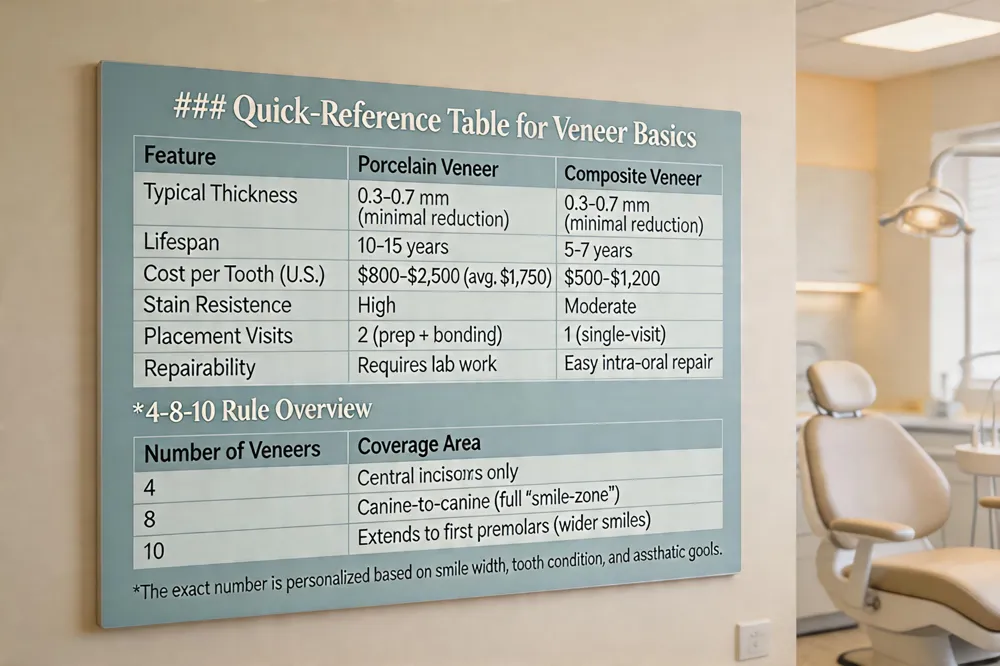
Quick‑Reference Table for Veneer Basics
| Feature | Porcelain Veneer | Composite Veneer |
|---|---|---|
| Typical Thickness | 0.3‑0.7 mm (minimal reduction) | 0.3‑0.7 mm (minimal reduction) |
| Lifespan | 10‑15 years | 5‑7 years |
| Cost per Tooth (U.S.) | $800‑$2,500 (avg. $1,750) | $500‑$1,200 |
| Stain Resistance | High | Moderate |
| Placement Visits | 2 (prep + bonding) | 1 (single‑visit) |
| Repairability | Requires lab work | Easy intra‑oral repair |
4‑8‑10 Rule Overview
| Number of Veneers | Coverage Area |
|---|---|
| 4 | Central incisors only |
| 8 | Canine‑to‑canine (full “smile zone”) |
| 10 | Extends to first premolars (wider smiles) |
The exact number is personalized based on smile width, tooth condition, and aesthetic goals.
 Dental veneers are ultra‑thin shells—either high‑quality porcelain or a composite resin—custom‑crafted to cover the front surface of a tooth. Porcelain veneers offer a natural translucency, stain resistance and a lifespan of 10‑15 years, while composite veneers are more affordable, can be placed in a single visit, and are easier to repair, though they may stain sooner. The placement process begins with a shade‑selection and digital smile design, followed by minimal enamel reduction (about 0.3‑0.7 mm), impression taking, laboratory fabrication, and final bonding with a light‑cured cement.
The "4‑8‑10 rule" is a quick‑guide dentists use to estimate how many veneers a patient may need for a balanced smile makeover. Four veneers cover only the central incisors, eight extend from canine to canine creating a symmetrical "smile zone," and ten reach the first premolars for wider smiles. This rule helps start the conversation, but the exact number is personalized based on smile width, tooth condition, and aesthetic goals.
Dentists may advise against veneers when a patient has severe decay, active gum disease, insufficient enamel, or uncontrolled bruxism, because the irreversible enamel removal can increase sensitivity and the thin shells may chip or debond. Additionally, veneers are a cosmetic, elective treatment that does not address underlying oral health issues and typically requires replacement after 10‑15 years, making long‑term maintenance and cost important considerations.
Cost of Veneers and Full‑Smile Makeovers
Cost Summary (U.S. & New Jersey)
| Material | Avg. Cost per Tooth (U.S.) | Avg. Cost per Tooth (NJ) |
|---|---|---|
| Porcelain | $800‑$2,500 (avg. $1,750) | $1,770 |
| Composite | $500‑$1,200 | $1,200 |
Full‑Mouth Makeover Price Ranges
| Treatment Scope | Approx. Price Range |
|---|---|
| 6‑8 Veneers (partial smile) | $5,000‑$15,000 |
| Veenstra Full Plan (porcelain + design + bonding) | $8,000‑$20,000+ |
| Complete Upper & Lower Front Porcelain Veneers | $16,000‑$40,000 (adds crowns/orthodontics) |
Financing options include CareCredit, in‑office plans, HSAs/FSAs.
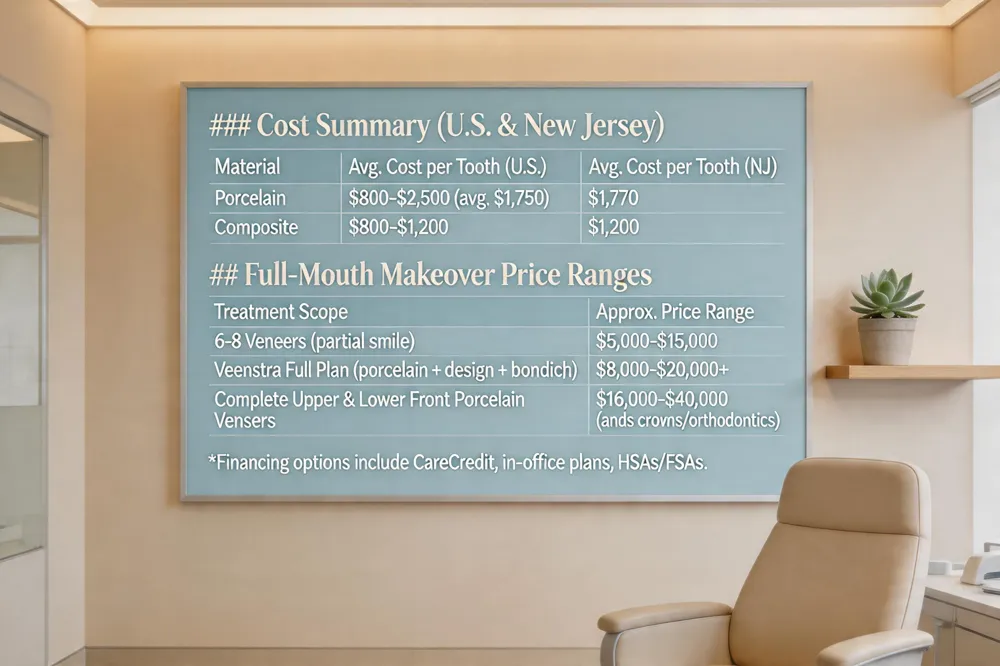 Dental veneers are a popular way to transform a smile, and the price depends on material, location and the number of teeth treated. In the United States a porcelain veneers typically costs $800‑$2,500 per tooth, with a national average of about $1,750; composite veneers are a more affordable option at $500‑$1,200 each. In New Jersey the average per‑tooth price rises slightly, ranging from $1,770 for porcelain to $1,200 for composite, reflecting local practice overhead and laboratory fees.
A full‑mouth makeover that uses six to eight veneers usually falls between $5,000 and $15,000, while a comprehensive Veenstra Family Dental plan that includes porcelain veneers, digital smile design and any needed bonding or gum work starts around $8,000 and can exceed $20,000. If a patient chooses a complete set of porcelain veneers for the upper and lower fronts, the total can reach $16,000‑$40,000, especially when crowns, orthodontics or implants are added.
Most offices offer flexible financing, CareCredit, and FSA/HSA options to spread the cost, and a free initial consultation provides an itemized estimate so you can plan a smile makeover that fits both your goals and budget.
Celebrity and Male Transformations
Notable Before/After Cases
| Patient | Before Issue | After Outcome |
|---|---|---|
| Tom Cruise | Uneven, chipped front teeth | Bright, seamless porcelain veneers |
| Kylie Jenner | Visible gap between front teeth | Gap closed, uniform white smile |
| Zac Efron | Yellowed, worn teeth | Flawless white smile for red‑carpet |
| Male Patient (Veenstra) | Discolored, chipped front teeth, gaps | Uniformly white, correctly sized, symmetric front line |
Images are available in the Veenstra gallery for visual reference.
 Veenstra Family Dental in Midland Park, NJ, uses digital smile design and high‑quality porcelain veneers to create natural, lasting results.
Before and after veneers men – Male patients often present discolored, chipped or slightly misaligned front teeth that age their smile. The "before" photo may show gaps, stains or uneven shapes. After custom‑fabricated porcelain veneers are bonded, the teeth become uniformly white, correctly sized and symmetrically aligned, giving a youthful, polished look and an immediate confidence boost.
Before and after veneers celebrity – Celebrities such as Tom Cruise, Kylie Jenner and Zac Efron have posted side‑by‑side images that illustrate veneer power. Tom Cruise’s early pictures show uneven, chipped teeth, while after porcelain veneers his grin is bright and seamless. Kylie Jenner’s before photo shows a noticeable gap that disappears after treatment, and Zac Efron’s red‑carpet smile changes from yellowed to flawless white.
Before and after veneer pictures – Veenstra’s gallery displays close‑up and full‑face photos. One patient with worn, yellowed front teeth receives ten veneers that restore length and brightness; another with post‑orthodontic “black‑triangle” gaps receives three veneers that close the spaces and reshape adjacent teeth. These visual comparisons help prospective patients envision their own smile makeover.
Real Patient Cases at Veenstra Family Dental
Sample Patient Cases
| Case # | Treatment | Number of Veneers | Additional Work | Result |
|---|---|---|---|---|
| 1 | Front‑tooth smile upgrade | 10 | None | Longer, whiter, perfectly aligned front teeth |
| 2 | “Black‑triangle” gap closure | 3 | None | Gaps closed, adjacent teeth reshaped |
| 3 | Extensive damage (chips + discoloration) | 4 veneers + 2 crowns | Crown placement on severely damaged teeth | Harmonious blend of veneers and crowns, restored strength |
| 4 | Post‑orthodontic aesthetic fix | 5 | None | Seamless transition from orthodontic results to final smile |
Each case showcases digital smile design planning and custom‑fabricated porcelain veneers.
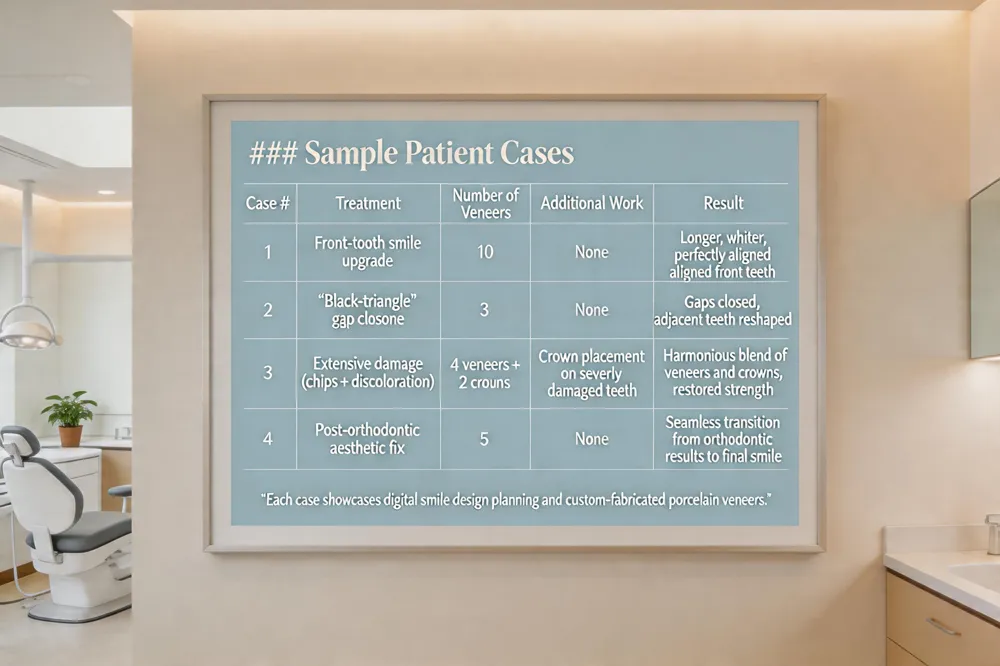 At Veenstra Family Dental we showcase a vibrant gallery of smile makeovers that illustrate the power of both front‑tooth veneers and full‑coverage crowns. Front‑tooth veneers are ideal for correcting chips, stains, gaps, and uneven shapes. Before treatment many patients present yellowed or dark front teeth, “black triangles” between teeth, or noticeable spacing. After the custom‑fabricated porcelain veneers are bonded, the smile appears longer, whiter, and perfectly aligned—creating a seamless, natural‑looking front dental line that boosts confidence. For teeth that have suffered more extensive damage, we combine thin veneers with porcelain crowns. Prior to restoration, these teeth often look worn, discolored, cracked, or have irregular gum lines. A thin veneer restores the front surface, while a crown encircles the entire tooth, restoring shape, strength, and color. The result is a harmonious smile where the restored teeth blend flawlessly with the surrounding dentition, giving patients an immediate sense of youthfulness and self‑esteem. Our modern digital smile design, compassionate team, and family‑focused atmosphere ensure each patient receives a personalized plan that delivers lasting, radiant results.
Financing, Insurance, and Payment Options
Financing & Payment Overview
| Option | Description | Typical Terms |
|---|---|---|
| CareCredit | Third‑party credit line, 0 % promotional periods | 6‑24 months, interest after promo |
| In‑Office Payment Plan | Down‑payment + monthly installments | Flexible, often 12‑18 months |
| HSAs / FSAs | Tax‑advantaged accounts for medically necessary work | May cover restorative portion, not pure aesthetics |
| Free Initial Consultation | Itemized estimate & budgeting session | No cost, helps choose best payment method |
Most insurance plans do not cover elective cosmetic veneers.
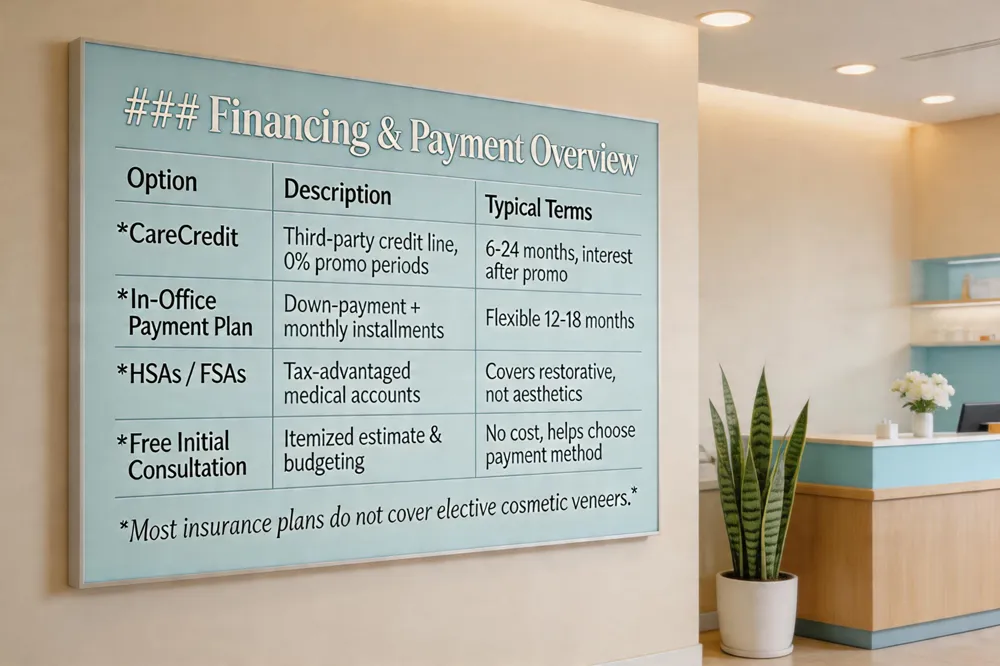 Because dental veneers are considered an elective cosmetic treatment, most dental insurance plans do not cover the cost. However, patients at Veenstra Family Dental and other modern cosmetic practices in New Jersey have several ways to make a smile makeover affordable.
Third‑party financing such as CareCredit is widely accepted and lets you spread the out‑of‑pocket expense over 6 to 24 months with 0% promotional interest periods. This option is especially helpful for a full‑arch makeover that can range from $8,000 to $20,000.
Flexible in‑office payment plans are also offered, allowing you to start treatment with a modest down‑payment and pay the balance in monthly installments. For those with Health Savings Accounts (HSAs) or Flexible Spending Accounts (FSAs), the portion of the veneer procedure that is deemed medically necessary—such as restoring a cracked tooth—may be billed to the account, though pure aesthetic work is usually ineligible.
During your free initial consultation, the dental team will create a personalized budget, discuss financing options, and help you choose the most comfortable payment method while maintaining the high‑quality, compassionate care you deserve.
Preparation, Placement, and After‑Care
Clinical Workflow & After‑Care Checklist
| Step | What Happens | Key Details |
|---|---|---|
| 1️⃣ Tooth Preparation | Minimal enamel removal (0.3‑0.7 mm) | Preserves most natural structure |
| 2️⃣ Shade Selection & Digital Smile Design | CAD/CAM planning, mock‑up preview | Patient‑involved design approval |
| 3️⃣ Impression / Scan | Intra‑oral scanner or traditional impression | Accurate lab model |
| 4️⃣ Laboratory Fabrication | Porcelain or composite shells created | Usually 1‑2 weeks (or same‑day CAD/CAM) |
| 5️⃣ Bonding | Light‑cured cement applied, veneers bonded | Final placement & polish |
| 6️⃣ Immediate Sensitivity Management | Desensitizing paste, night guard if needed | Addresses 0.3‑0‑7mm |
| **7 Long | ||
| Maintenance** | Brush with non‑abrasive fluoride toothpaste, floss daily, regular check‑ups | Avoid teeth as tools, limit staining drinks |
Longevity: Porcelain 10‑15 years, Composite 5‑7 years.
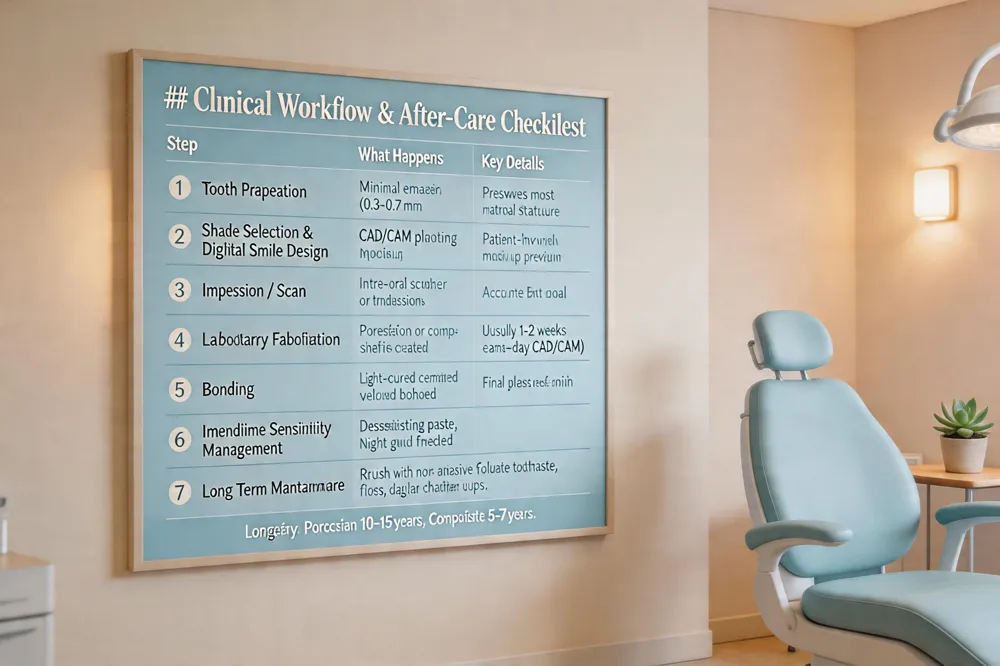 When you decide to enhance your smile with veneers, the first step is a gentle tooth‑preparation that removes only 0.3‑0.7 mm of enamel – about the thickness of a fingernail. This minimal reduction creates space for the thin porcelain or composite shell while preserving most of the natural tooth structure. At Veenstra Family Dental we use digital smile design and CAD/CAM technology to map the exact reduction needed, ensuring a precise, comfortable fit.
Because enamel is permanently altered, some patients experience short‑term sensitivity to hot or cold foods. We manage this with a desensitizing paste and, for those who grind or clench, a custom‑fabricated night guard to protect the new restorations from chipping or debonding.
Long‑term maintenance is simple but essential: brush twice daily with a non‑abrasive fluoride toothpaste, floss daily, and schedule regular check‑ups. Avoid using your teeth as tools and limit highly staining drinks. With diligent care, porcelain veneers can last 10‑15 years, while composite veneers remain beautiful for 5‑7 years. Remember, veneers are a cosmetic solution and may not be advised for teeth with untreated decay, gum disease, or insufficient enamel, as the irreversible enamel removal could compromise oral health and increase future sensitivity.
Advanced Smile Design Technology at Veenstra
Digital Workflow Benefits
| Technology | Benefit |
|---|---|
| High‑Resolution Scanning / Photography | Captures exact tooth morphology and shade |
| CAD Software Preview | Real‑time visual of final smile, patient can request tweaks |
| CAD/CAM Milling (in‑office) | Same‑day fabrication, reduced misfit risk |
| No‑Prep (Ultra‑Thin) Veneers | Little‑to‑no enamel reduction, ideal for minimally invasive cases |
| Digital Shade Matching | Consistent, accurate color selection |
Result: Precise fit, comfortable bite, natural translucency, and shortened treatment time.
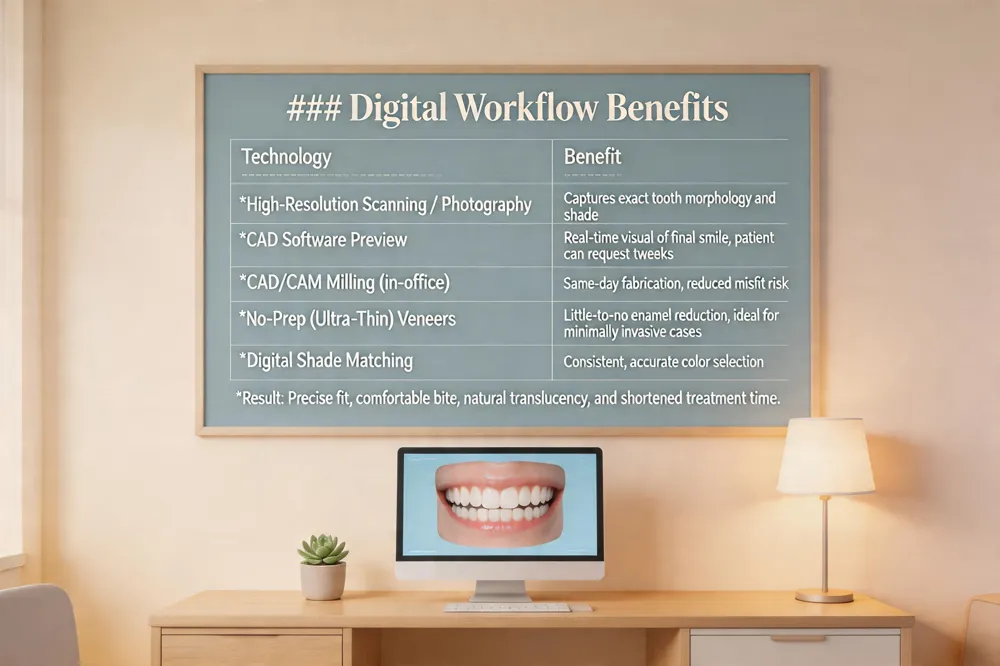 Veenstra Family Dental leverages cutting‑edge digital smile design and CAD/CAM milling to create veneers that fit like a second set of natural teeth. During the first visit, a high‑resolution scan or digital photograph captures the exact shape, shade, and alignment of each tooth. Using CAD software the dentist and patient can preview the final smile in real time, making adjustments to tooth length, width, or color before any tooth structure is altered.
For patients who prefer a minimally invasive approach, Veenstra offers no‑prep (or ultra‑thin) veneers that require little to no enamel reduction. The digital workflow ensures that the laboratory‑fabricated porcelain shells match the previewed design precisely, resulting in a seamless bond, comfortable bite, and a natural translucency that mimics real enamel.
Because the veneers are custom‑crafted in a single day using in‑office milling, treatment time is shortened and the risk of misfit is dramatically reduced. The combination of digital planning, CAD/CAM precision, and optional no‑prep techniques gives every patient a tailored, confidence‑boosting smile with optimal fit and comfort.
Myths and Facts: Gwen Stefani and Dentures
Veneers vs. Dentures – Quick Comparison
| Feature | Porcelain Veneers | Dentures |
|---|---|---|
| Purpose | Cosmetic enhancement of existing teeth | Replace missing teeth (partial or full arch) |
| Enamel Removal | Minimal (0.3‑0.5 mm) | None (removable prosthetic) |
| Bonding | Bonded to front of natural teeth | Not bonded; sits on gum tissue |
| Longevity | 10‑15 years (porcelain) | 5‑10 years (depending on material) |
| Maintenance | Routine oral hygiene, occasional polishing | Daily cleaning, occasional relining |
| Gwen Stefani | Uses porcelain veneers, not dentures | — |
Veneers provide a quick, aesthetic fix with minimal preparation, while dentures are a full‑arch solution for missing teeth.
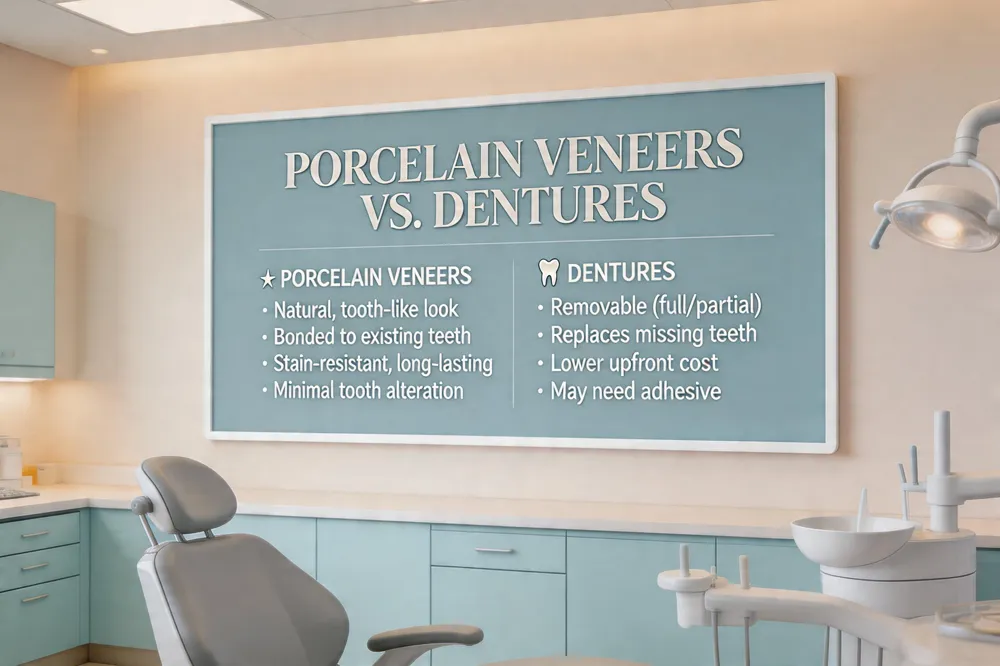 There’s a lot of buzz about celebrity smiles, and one of the most persistent rumors involves Gwen Stefani’s teeth. Does Gwen Stefani have dentures? No—Gwen Stefani does not wear dentures. At 55 years old she chose a modern cosmetic solution rather than full‑arch replacements. She received natural‑looking porcelain veneers that corrected her gummy smile and gave her a polished, white‑tooth appearance. Porcelain veneers are ultra‑thin shells that bond to the front of existing teeth, preserving the natural dentition while hiding imperfections such as gaps, chips, or discoloration. This is fundamentally different from dentures, which are removable prosthetics used when many or all teeth are missing and require a completely new base. Veneers provide a quick, aesthetic fix with minimal enamel removal (about 0.3‑0.5 mm), whereas dentures involve extensive preparation and are not bonded to remaining teeth. In Gwen’s case, the veneers were crafted using digital smile design at a professional practice, ensuring a seamless, long‑lasting result that boosts confidence without the bulk or maintenance of dentures.
Your Path to a Radiant, Confident Smile
Veneers offer a quick, minimally invasive way to transform chips, stains, gaps and mild misalignment into a bright, uniform smile. Porcelain veneers provide natural translucency, stain resistance and a lifespan of 10‑15 years, while composite options are more affordable and can be placed in a single visit. The procedure involves a brief enamel reduction (0.3‑0.5 mm), digital impressions, laboratory fabrication and bonding with light‑cured cement. Proper oral hygiene, regular check‑ups and a night guard for bruxism protect the restoration and prolong its durability. At Veenstra Family Dental we combine advanced digital smile design, compassionate care and a family‑focused atmosphere. Schedule your free initial consultation today and let our expert team create a personalized treatment plan for the smile you deserve. We’ll discuss financing options and answer all your questions.