Why 3D Printing Matters for Modern Dentistry
Three‑dimensional printing transforms the patient experience by delivering night guards and retainers that match the exact contours of each individual's teeth, eliminating the discomfort of bulky, ill‑fitting stock devices. A digital intra‑oral scan is captured in a single visit, then a CAD model is sent to an on‑site printer; the appliance can be cured, finished and handed to the patient within hours, shrinking turnaround from weeks to a single day. Practices save money because material costs are low (often under $35 per guard) and labor is reduced, translating into higher profit margins and more affordable fees for patients. All resins used are FDA‑cleared, ISO‑compliant and biocompatible, ensuring long‑term safety for intra‑oral use.
From Scan to Appliance: The Digital Workflow
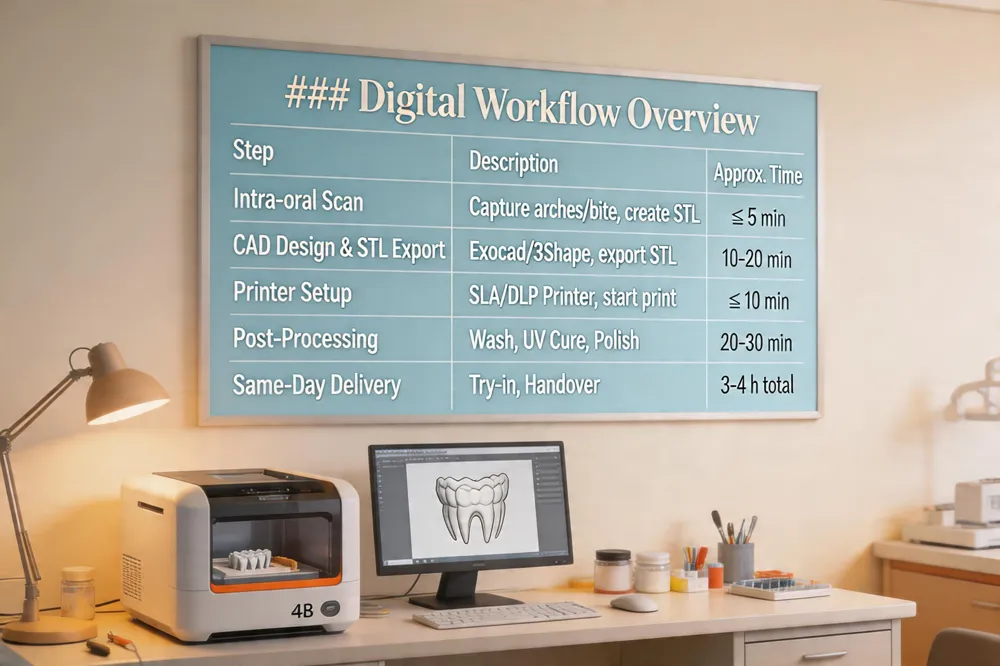
Digital Workflow Overview
| Step | Description | Approx. Time |
|---|---|---|
| Intra‑oral Scan | Handheld scanner captures upper, lower arches and bite relationship, creates STL file | ≤ 5 min |
| CAD Design & STL Export | Import STL into Exocad/3Shape/SprintRay Cloud, adjust thickness, occlusal coverage, offsets, export final STL | 10‑20 min |
| Printer Selection & Setup | Load STL into SLA/DLP printer (Form 4B/4BL, SprintRay Pro S, Roland 3DX PRINT 4K), auto‑nest, start print | ≤ 10 min |
| Post‑Processing | Automated wash (ProWash/ultrasonic), UV cure (ProCure 2, Form Cure L V2), polishing | 20‑30 min |
| Same‑Day Delivery | Try‑in, adjustments, hand‑over to patient | 3‑4 h total |
 Intra‑oral digital scanning
Modern practices start with a comfortable, tray‑free intra‑oral scan. A handheld scanner captures the upper, lower and bite relationship in under five minutes, creating a precise STL file that eliminates messy impressions and improves patient comfort.
Intra‑oral digital scanning
Modern practices start with a comfortable, tray‑free intra‑oral scan. A handheld scanner captures the upper, lower and bite relationship in under five minutes, creating a precise STL file that eliminates messy impressions and improves patient comfort.
CAD design and STL export The digital model is imported into dental CAD software (Exocad, 3Shape Splint Studio, or SprintRay Cloud). Clinicians design the night guard or retainer, adjusting thickness, occlusal coverage and offsets. Once the design is finalized, an STL file is exported for printing.
Printer selection and set‑up Chair‑side offices often choose fast, user‑friendly SLA/DLP printers such as SprintRay’s Pro S, Formlabs Form 4B/4BL or the FormDX PRINT 4K LCD printer. These machines accept the STL, auto‑nest the build, and begin printing in under ten minutes. Resin choice is guided by the appliance’s needs: NightGuard Flex for a slightly flexible feel, NightGuard Firm for heavy bruxers, or Dental LT Clear for a rigid, clear guard.
Post‑processing (washing, curing, polishing) After printing, the part is washed in an automated ProWash/Dry or ultrasonic bath, then cured in a UV unit (ProCure 2 or Form Cure L V2 (https://dental.formlabs.com/)) to achieve full polymerization. A brief polishing step removes support marks and creates a smooth, patient‑friendly surface.
Same‑day delivery From scan to finished appliance can be completed in 3–4 hours, allowing the dentist to try‑in, adjust and hand the guard to the patient in a single visit. This rapid turnaround reduces chair‑time, eliminates multiple appointments and dramatically improves patient satisfaction.
What 3D printers do dentists use? Dentists rely on SLA/DLP systems such as Formlabs Form 4B/4BL, SprintRay Pro S, and Roland 3DX PRINT 4K LCD. These printers combine high resolution (25–50 µm layer thickness) with automated workflows, making them ideal for in‑house night‑guard fabrication.
Dental 3D printer comparison Formlabs offers a broad resin library and intuitive PreForm software; SprintRay provides AI‑assisted cloud design and rapid Pro S printing; Roland’s 3DX PRINT 4K LCD delivers large build volumes at a modest monthly lease. Choose the system that matches your practice’s volume and budget.
Dental 3D printer resin Biocompatible resins such as NightGuard Flex, NightGuard Firm, Dental LT Comfort, and Dental LT Clear are FDA‑cleared for intra‑oral use, providing the right balance of flexibility, strength and comfort for custom night guards.
Can you 3D print night guards? Yes. With a digital scan, CAD design and a suitable resin printer, a patient‑specific night guard can be printed, post‑cured and polished in under an hour, delivering a precise, comfortable, and durable appliance on the same day.
Choosing the Right Printer for Your Practice
Printer Comparison Snapshot
| Printer | Technology | Build Volume (mm) | Layer Thickness | Notable Features | Approx. Price |
|---|---|---|---|---|---|
| Formlabs Form 4B/4BL | Low‑Force SLA | 145 × 145 × 175 | 25‑300 µm | PreForm workflow, extensive resin library, FDA‑cleared resins | $12‑$14 k (full package) |
| SprintRay Pro S | DLP | 120 × 68 × 170 | 25‑50 µm | AI‑assisted cloud design, integrated ProWash/ProCure, fast prints | $10‑$11 k |
| Roland 3DX PRINT 4K LCD | LCD | 230 × 130 × 200 | 50‑100 µm | Large build area, modest lease options | $8‑$10 k (lease) |
| Asiga Ultra 50 UV | UV‑cured SLA | 217 × 122 × 200 | 25‑50 µm | Open‑material system (>650 validated resins), high precision | $14‑$15 k |
| LuxCreo iLux Pro Dental | LCD | 210 × 118 × 150 | 25‑75 µm | Cloud‑based workflow, U.S. support line 650‑336‑0888 | $14‑$15 k |
| Anycubic Photon Mono M5s (entry‑level) | LCD | 165 × 102 × 150 | 35‑50 µm | Low cost, good for low‑volume offices | $600‑$1.2 k |
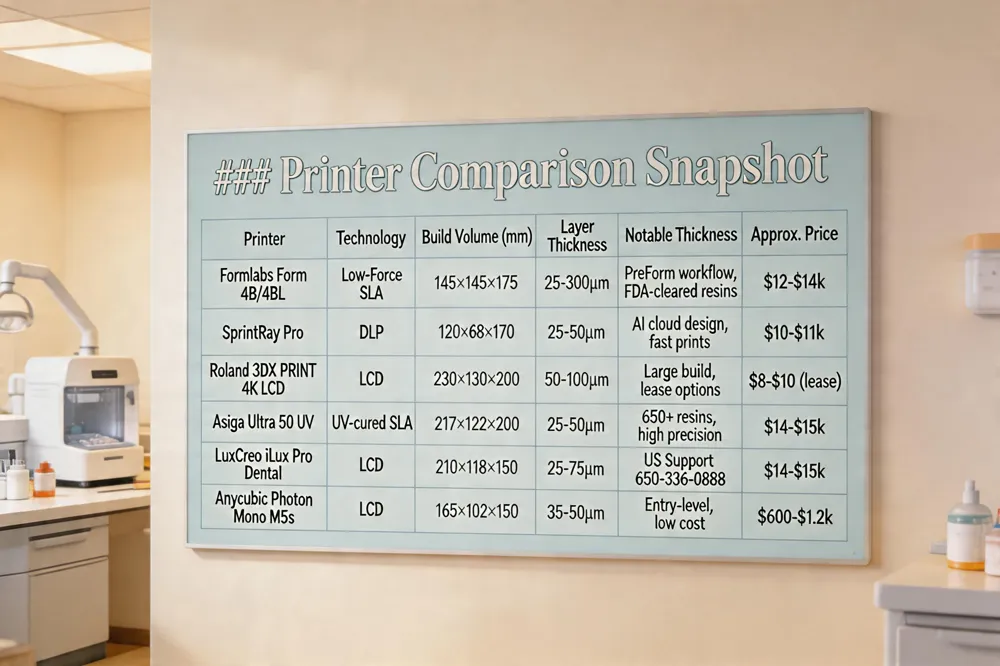 Why the printer matters – Modern dental offices are moving from weeks‑long lab shipments to same‑day delivery of night guards, retainers, and clear aligners. The key is a reliable 3‑D printer that matches your practice’s volume, material needs, and budget.
Printer technologies – SLA and DLP (laser‑ or light‑cured resins) dominate the dental market because they produce smooth, biocompatible parts with micron‑level accuracy. PolyJet (Stratasys J5 DentaJet) and Multi‑Jet Fusion (HP MJF) offer multi‑material and high‑throughput options for larger labs, while DLP printers such as SprintRay’s Pro S deliver rapid cure times (under 45 minutes for a night guard).
Brand differences and price points – Leading manufacturers include Formlabs (Form 4B (or Form 4BL)), SprintRay, Asiga, LuxCreo, and Stratasys. Prices range from entry‑level models (Anycubic Photon Mono M5s $600‑$1,200) to premium systems (Formlabs Premium package $14,294, Asiga Ultra 50 UV $14,990). A quick price snapshot: FlashForge Focus Ultra $2,495‑$4,495; SprintRay Pro 2 $10,995; Asiga MAX 2 UV $9,990; LuxCreo iLux Pro Dental $14,999.
Best dental 3D printer for a family‑focused office – The Form 4B (or Form 4BL) is widely regarded as the top choice. Its Low‑Force SLA technology offers exceptional accuracy, a user‑friendly PreForm workflow, and an extensive library of FDA‑cleared resins (e.g., Dental LT Clear, Dental LT Comfort). It supports same‑day printing of night guards and aligners while keeping failure rates low.
Asiga and SprintRay highlights – Asiga printers provide micron‑level precision, an open‑material system (>650 validated resins), and a 217 × 122 × 200 mm build volume for versatile in‑office production. SprintRay excels with AI‑assisted cloud design, fast Pro S printing, and integrated post‑processing (ProWash, ProCure 2), enabling practices to cut outsourcing costs and deliver custom appliances within hours.
Build volume, speed, and software ecosystems – Consider the size of the parts you’ll print (full‑arch models vs. single night guards) and the printer’s layer cure speed. Modern systems bundle intuitive CAD/AI tools (RayWare, PreForm, LuxCreo’s Cloud) and provide U.S. technical support (e.g., LuxCreo’s 650‑336‑0888 line) to keep your workflow smooth and patient‑friendly.
Choosing the right printer empowers your practice to offer personalized, comfortable, and efficient dental care for patients of all ages.
Materials That Make Night Guards Comfortable and Strong
Night‑Guard Resin Properties
| Resin | Flexibility / Modulus | Strength (MPa or J/m) | Typical Use Case | FDA‑Cleared |
|---|---|---|---|---|
| NightGuard Flex (SprintRay) | Slightly flexible, softens at mouth temperature | Impact strength 118 J/m (≈ 2× competing) | Light‑moderate bruxers, comfort‑focused | Yes |
| NightGuard Firm (SprintRay) | Rigid, high modulus 2452 MPa | Flexural strength 119 MPa | Heavy bruxers, high‑force protection | Yes |
| Dental LT Comfort (Formlabs) | Soft, translucent | Flexural strength ~80 MPa | Patient‑specific splints, daytime wear | Yes |
| Dental LT Clear (Formlabs) | Rigid, clear | Flexural strength ~90 MPa | Clear night guards, aesthetic preference | Yes |
| TrueSplint Crystal‑Clear Resin | Rigid yet slightly flexible, resists yellowing | Not specified (high fracture resistance) | Aesthetic clear guards, long‑term use | Yes |
| Comfort 3D™ Bite Splint (generic) | Hard‑yet‑flexible | Not specified | Protect veneers, crowns, TMJ relief | Yes |
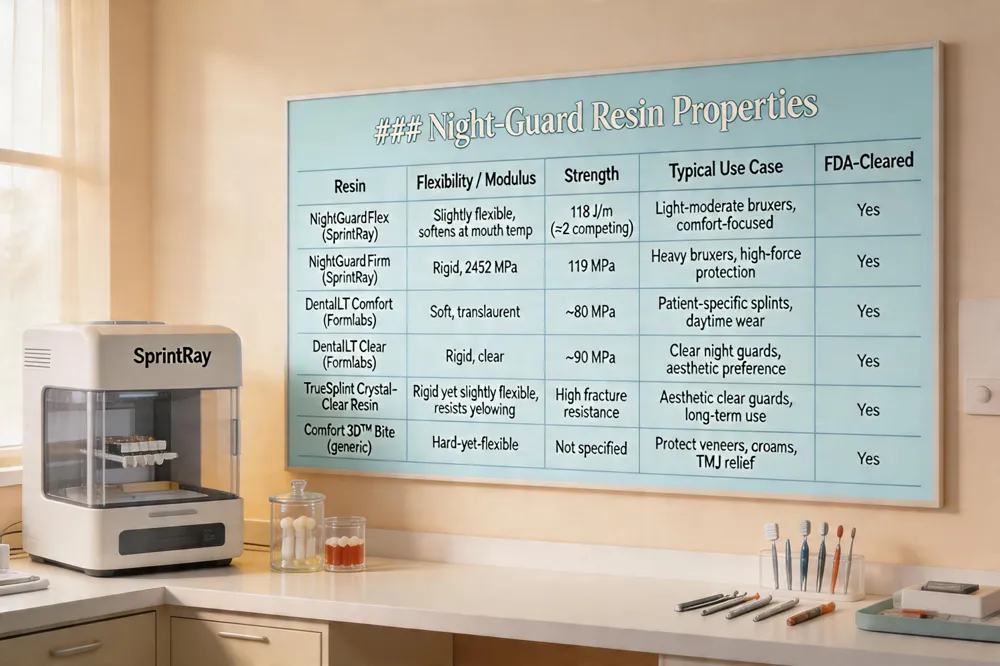 Modern 3D‑printed night guards rely on biocompatible, FDA‑cleared resins that balance flexibility with rigidity for optimal patient comfort. SprintRay’s NightGuard Flex resin softens when warmed, delivering an impact strength of 118 J/m—more than double many competing materials—while NightGuard Firm provides a flexural strength of 119 MPa and a modulus of 2452 MPa for heavy bruxers. Formlabs’ Dental LT Comfort and Dental LT Clear resins offer a translucent, soft option for splints and a clear, fracture‑resistant alternative for rigid guards. TrueSplint’s crystal‑clear UV‑cured resin resists yellowing and maintains a precise fit. All of these materials are odorless, safe for long‑term intra‑oral use, and support same‑day delivery thanks to rapid SLA/DLP printing workflows. The Comfort 3D™ Bite Splint, a hard‑yet‑flexible appliance printed from a light‑cured resin, exemplifies this blend of strength and comfort; it protects veneers, crowns and natural teeth while relieving TMJ pain, and comes with a six‑month warranty. Priced at $96 per splint, it offers a cost‑effective, patient‑specific solution. In practice, the digital workflow—from intra‑oral scan to CAD design to printer—reduces turnaround from weeks to under an hour, eliminates uncomfortable impression trays, and improves fit accuracy, ensuring a comfortable, durable night guard that patients are eager to wear.
In‑Office Clear Aligner Production
Clear Aligner Production Workflow
| Stage | Tool / Software | Resin Used | Approx. Time |
|---|---|---|---|
| Intra‑oral Scan | Handheld scanner (e.g., iTero, Trios) | – | 2‑5 min |
| CAD Generation | Align Technology/3Shape/Proprietary AI design | – | 5‑10 min |
| Print Preparation | PreForm / RayWare / LuxCreo Cloud (nesting) | NightGuard Flex or Dental LT Clear | 2‑5 min |
| 3‑D Printing | SLA/DLP printer (Form 4B, SprintRay Pro S) | Selected resin | 30‑45 min per tray |
| Post‑Processing | Automated wash, UV cure, polishing | – | 10‑15 min |
| Delivery | Try‑in, final adjustments, hand‑over | – | Same‑day or next‑day |
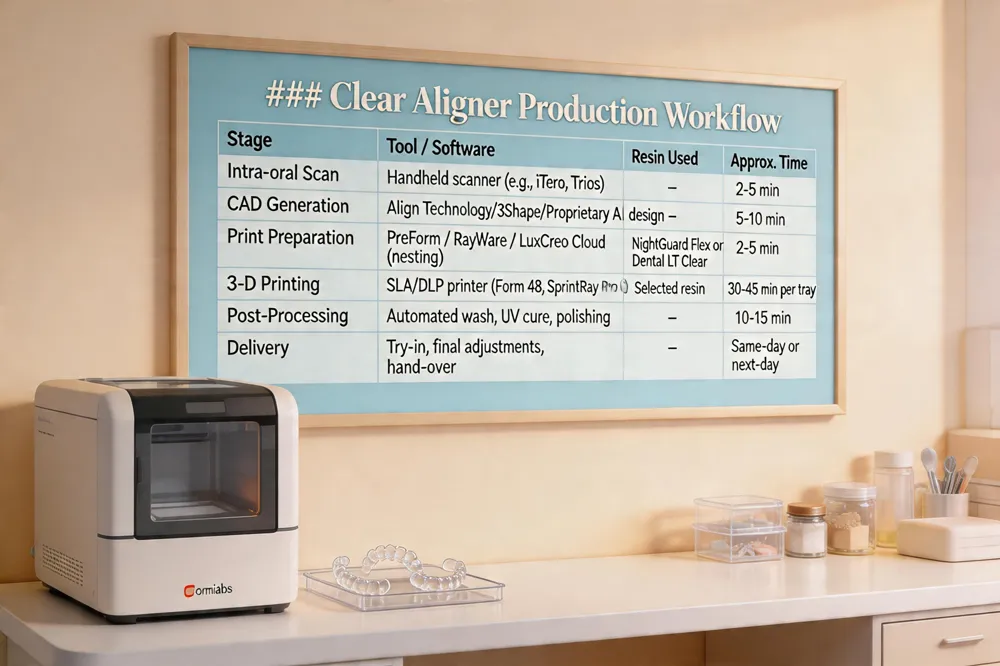 Modern dental offices like Veenstra Family Dental can now design, print, and deliver custom clear aligners in a single visit. The workflow starts with an intra‑oral scanner that captures a high‑resolution 3‑D image of the patient’s dentition in just a few minutes. The scan is imported into CAD software, which automatically generates the exact shape and thickness of each aligner tray. The digital model is then sent to a high‑resolution 3‑D printer—often a SprintRay Pro or Form 4B—where it is printed in a biocompatible resin such as NightGuard Flex or Dental LT Clear. Compared with traditional thermo‑forming, direct printing eliminates the intermediate stone model, reduces material waste, and shortens turnaround from weeks to a matter of hours. The resin choice depends on the clinical need: flexible resins provide comfort for nighttime wear, while rigid, high‑strength resins give maximum protection for heavy bruxers. Because the entire process happens in‑office, patients enjoy same‑day or next‑day delivery, lower costs, and a personalized fit that improves comfort and compliance. This digital, chair‑side approach embodies Veenstra’s commitment to family‑focused, technology‑driven care while keeping orthodontic treatment affordable and convenient.
Economic and Clinical Benefits for Patients and Practices
Economic & Clinical Impact Summary
| Benefit | Metric | Value |
|---|---|---|
| Cost per Night Guard (in‑house) | $3‑$10 for material, <$35 total | vs. $80‑$150 outsourced |
| Turnaround Time | 3‑4 h (same‑day) | vs. weeks for lab‑ |
| Accuracy (RMS deviation) | 129 ± 16 µm | vs. 177 ± 25 µm for alginate |
| Layer Thickness (printer) | 25‑100 µm | micron‑level detail |
| Patient Satisfaction | Higher due to comfort, fast delivery | Qualitative ↑ |
| Compliance Rate | Improved with custom fit & comfort | Qualitative ↑ |
| Travel/Time Savings | Single appointment | vs. multiple lab visits |
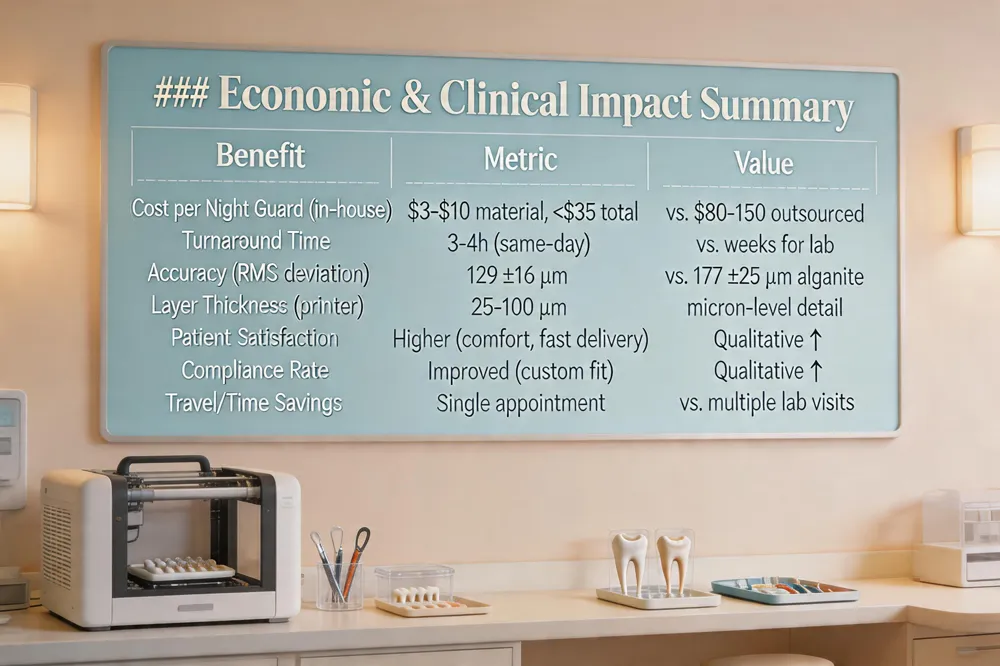 The shift to 3‑D‑printed splints and night guards brings measurable savings and a smoother patient journey. In‑house printing reduces material costs to just $3‑$10 per splint, and a typical night guard can be produced for under $35, compared with $80‑$150 when outsourced. Because the digital workflow eliminates the need for impression trays, shipping, and multiple lab visits, the overall turnaround drops from weeks to a single appointment, saving patients time and travel expenses.
Accuracy improves dramatically. Intra‑oral digital scanning captures the teeth in 10‑20 µm detail, and SLA/DLP printers lay down layers as thin as 25‑100 µm. Studies show RMS deviations of 129 ± 16 µm, far better than traditional alginate impressions (≈177 ± 25 µm). The result is a night guard that fits precisely, distributes occlusal forces evenly, and feels comfortable, which boosts patient satisfaction and compliance.
Higher compliance is linked to comfort and convenience. Materials such as SprintRay NightGuard Flex, Formlabs Dental LT Comfort, and TrueSplint’s crystal‑clear resin soften at mouth temperature or remain rigid for heavy bruxers, providing a personalized fit that patients are more likely to wear consistently. Faster delivery, lower cost, and a perfect fit together create a positive experience, encouraging regular use and better long‑term outcomes for bruxism, TMJ disorders, and post‑operative protection.
Embracing 3D Printing for a Brighter, Healthier Smile
Dental practices are transforming smiles with 3D printing, creating a comfortable patient experience. Scanners capture impressions in a visit, eliminating trays and reducing chair time. The data is instantly converted into a 3‑D CAD model and printed on‑site, allowing delivery of night guards and clear aligners that fit perfectly, improve comfort, and boost compliance. In‑house printing cuts outsourcing costs by up to $30 per appliance and shortens turnaround from weeks to hours, driving revenue growth and staff for optimal care. Looking ahead, AI‑driven design and multi‑material printers promise faster orthodontic solutions, cementing digital dentistry as the future of oral health.