Brief Overview
Minor imperfections—such as tiny chips, narrow gaps, mild discoloration, or slightly misshapen front teeth—can affect confidence but often require only subtle correction. Dental bonding and porcelain veneers have become popular because they address these issues quickly, cost‑effectively, and with natural‑looking results. At Veenstra Family Dental we evaluate each patient’s smile goals, oral health, and lifestyle to recommend the best option. For small, isolated flaws we often choose a single‑visit bonding that preserves most enamel, while larger gaps, deep stains, or extensive shape changes are treated with custom‑fabricated veneers after a brief enamel preparation. Our modern, welcoming practice ensures a personalized, comfortable experience for all ages.
Basics, Costs and Pros‑Cons of Bonding vs. Veneers
Bonding vs. Veneers – Quick Comparison
| Aspect | Dental Bonding | Porcelain Veneers |
|---|---|---|
| Procedure Steps | Shade selection → Light etching → Resin application → Light‑curing → Polishing (single 30‑60 min visit) | Consultation → Tooth preparation (≈0.5 mm enamel removal) → Impression → Laboratory fabrication → Final bonding (2‑3 visits) |
| Cost (per tooth) | $100‑$400 (typical $200‑$300) | $800‑$2,500 (porcelain higher) |
| Typical Lifespan | 3‑7 years (may need polishing/re‑bond) | |
| Key Advantages | Quick, affordable, minimally invasive, reversible | Superior stain resistance, natural translucency, durable, long‑term aesthetic |
| Key Disadvantages | Stains more easily, chips, shorter lifespan | Higher cost, irreversible enamel removal, multiple appointments |
| Insurance Coverage | May be covered when restorative (function‑restoring) | Usually cosmetic → not covered |
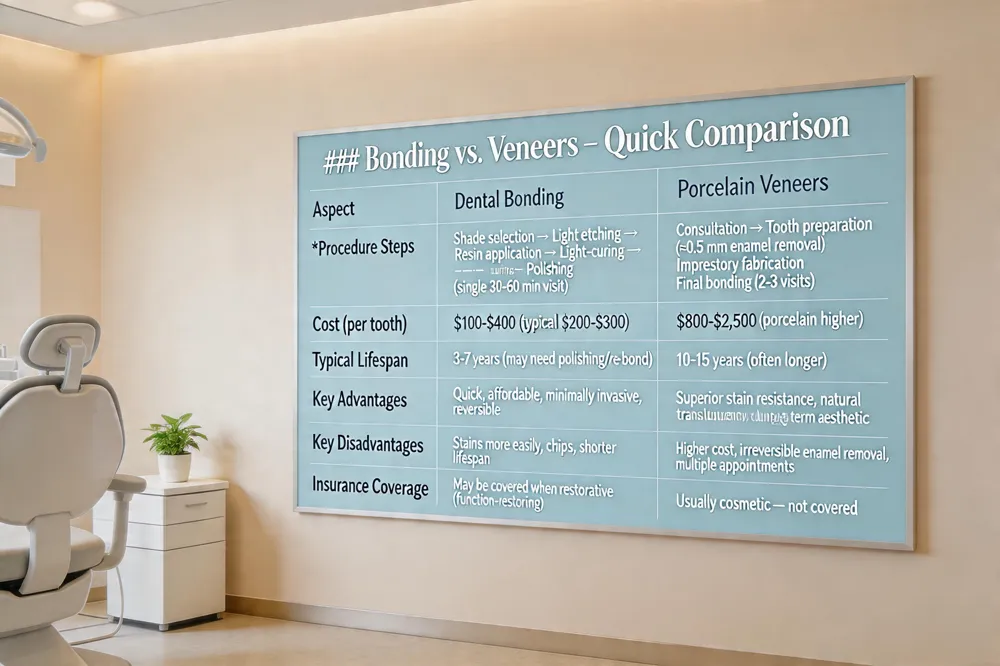 Dental bonding applies a tooth‑colored composite resin directly to the tooth, sculpted and light‑cured in a single 30‑60‑minute visit with little or no enamel removal. Porcelain veneers are thin, custom‑fabricated ceramic shells that cover the front of a tooth after a small (≈0.5 mm) enamel reduction and typically require two to three appointments.
Typical procedure steps – Bonding: shade selection, light etching, resin application, curing, polishing. Veneers: consultation, tooth preparation, impression, laboratory fabrication, final bonding.
Cost ranges – Bonding costs $100‑$400 per tooth (often $200‑$300); veneers cost $800‑$2,500 per tooth, with higher fees for porcelain and lab work. Insurance may cover bonding when restorative, but veneers are usually cosmetic and not covered.
Key advantages & disadvantages – Bonding is quick, affordable, minimally invasive, and reversible, but the resin stains more easily, chips, and lasts 3‑7 years. Veneers offer superior stain resistance, natural translucency, and a 10‑15‑year lifespan, yet they are more expensive, irreversible, and require enamel removal.
Veneers vs bonding Reddit – Users note bonding is a fast, budget‑friendly fix for minor flaws, while veneers are praised for long‑term durability and aesthetics despite higher cost.
Cosmetic dental surgery cost – Prices vary widely; simple whitening $100‑$1,000, veneers $900‑$2,500 per tooth, full smile makeovers $10,000‑$30,000. Financing and personalized treatment plans available at Veenstra Family Dental.
Dental bonding cost – $100‑$400 per tooth; Veenstra keeps fees within this range and provides a complimentary consultation.
Veneers vs bonding pros and cons – Bonding: fast, low‑cost, minimal prep; less durable, prone to staining. Veneers: durable, stain‑resistant, natural look; higher cost, enamel removal, multiple visits.
Veneers vs bonding cost – Bonding $100‑$400 per tooth; porcelain veneers $500‑$2,500 per tooth, with longer longevity offsetting the upfront expense.
Restorative Options Beyond Bonding and Veneers
Restorative Options – Overview
| Option | Indications | Common Materials | Typical Steps | Main Pros | Main Cons |
|---|---|---|---|---|---|
| Dental Crown (Cap) | Extensive decay, cracked tooth, post‑root‑canal tooth | Metal (gold/base‑metal), Porcelain‑fused‑to‑Metal (PFM), All‑ceramic (zirconia, lithium disilicate), Composite (temporary) | Exam → Digital scan → Minimal reduction → Impression → Temporary crown → Lab fabrication → Cementation | Restores strength & shape; long‑term durability | Requires tooth reduction; higher cost than bonding |
| Onlay / Partial Veneer | Large chip, misshapen tooth, moderate loss of structure | Ceramic or composite | Exam → Minimal prep → Impression → Lab fabrication → Bonding | Preserves more natural tooth; good aesthetics | Limited to partial coverage; may need future full crown |
| In‑lay / On‑lay (indirect filling) | Moderate cavities where direct filling isn’t ideal | Porcelain, Gold, Composite | Decay removal → Impression → Lab fabrication → Cementation | Strong, well‑fitted restoration; less tooth removal than crown | More appointments than direct filling |
| **Implant‑support | Bridge** | Missing teeth, adjacent teeth healthy | Titanium implant + porcelain/ceramic bridge | Implant placement → Healing → Abutment → Bridge fabrication → Placement | Replaces missing teeth permanently; preserves bone |
| Dentures (partial/full) | Multiple missing teeth, patient preference for removable | Acrylic resin, Metal‑reinforced acrylic | Impressions → Try‑in → Final fabrication → Delivery | Non‑surgical; cost‑effective for many teeth | Less stable than implants; maintenance required |
| Root Canal + Crown | Infected pulp, structural compromise | Usually metal‑ceramic or all‑ceramic crown | Diagnosis → Access → Cleaning → Obturation → Crown prep & placement | Saves natural tooth; restores function | Multiple visits; cost higher than simple filling |
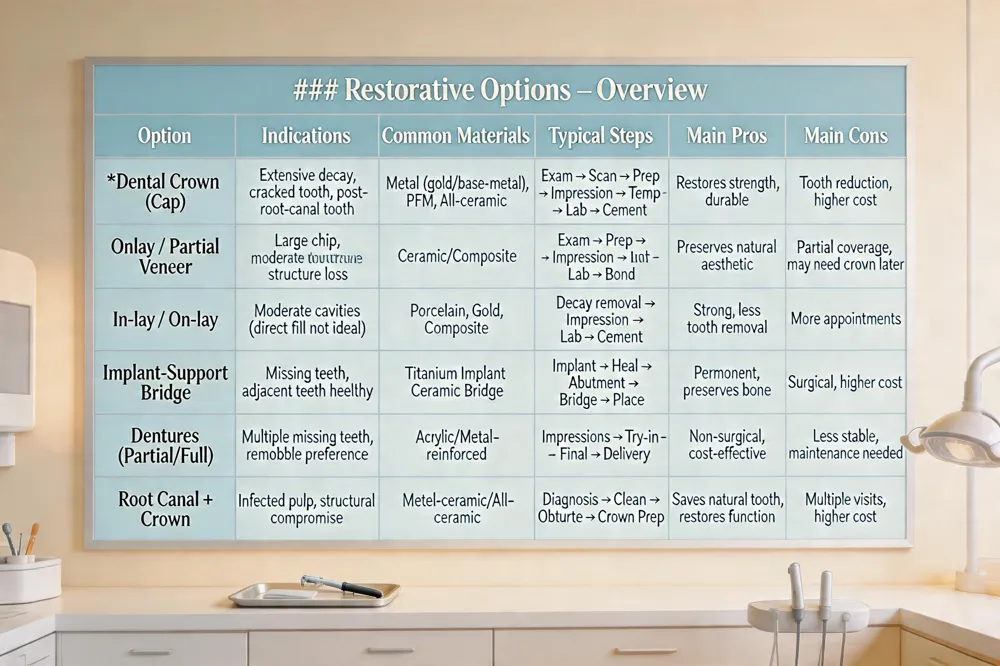 Dental crowns—also called caps—are custom‑made shells that completely cover a damaged tooth, restoring strength, shape, and appearance. Materials range from metal (gold or base‑metal alloys) for durability, to porcelain‑fused‑to‑metal (PFM) for a natural look, to all‑ceramic options such as zirconia, lithium disilicate (E‑max) for front teeth, and resin‑based composites for temporary use. When a tooth has extensive decay, a crack, or follows a root‑canal, a crown is the preferred permanent cover. The procedure begins with a thorough exam and digital scan, followed by minimal tooth reduction, an impression, a temporary crown, and finally the cementing of the lab‑fabricated restoration. Onlays—partial veneers that cover only the front surface—preserve more natural tooth structure and are ideal for large chips or misshapen teeth. Dentists may discourage veneers if gum disease, insufficient enamel, or bruxism are present, because these conditions compromise bonding and longevity. Non‑cosmetic restorative care includes preventive cleanings, fluoride treatments, fillings, in‑lays, root canals, bridges, implants, dentures, and periodontal therapy. Choosing the right option depends on the tooth’s location, functional demands, and your aesthetic goals, and a personalized consultation will guide the best choice for your smile.
Visual Results and Patient Perception
Visual Impact & Patient Perception
| Feature | Dental Bonding | Porcelain Veneers |
|---|---|---|
| Appearance | Polished composite blends with adjacent teeth; may show subtle texture | Glass‑like ceramic shell; high gloss, uniform translucency |
| Before‑After Change | Minor cosmetic fix (chips, gaps, mild stains) | Dramatic transformation (color, shape, uniformity) |
| Longevity of Look | 3‑7 years before polishing/re‑bond needed | 10‑15 years or more, resistant to stains & chips |
| When Removed | Tooth may appear dull/matte, slight surface unevenness | No removal under; if veneer fails, underlying tooth is intact after removal |
| Patient Satisfaction | Quick result, budget‑friendly, good for minor flaws | Long‑term aesthetic satisfaction, higher upfront investment |
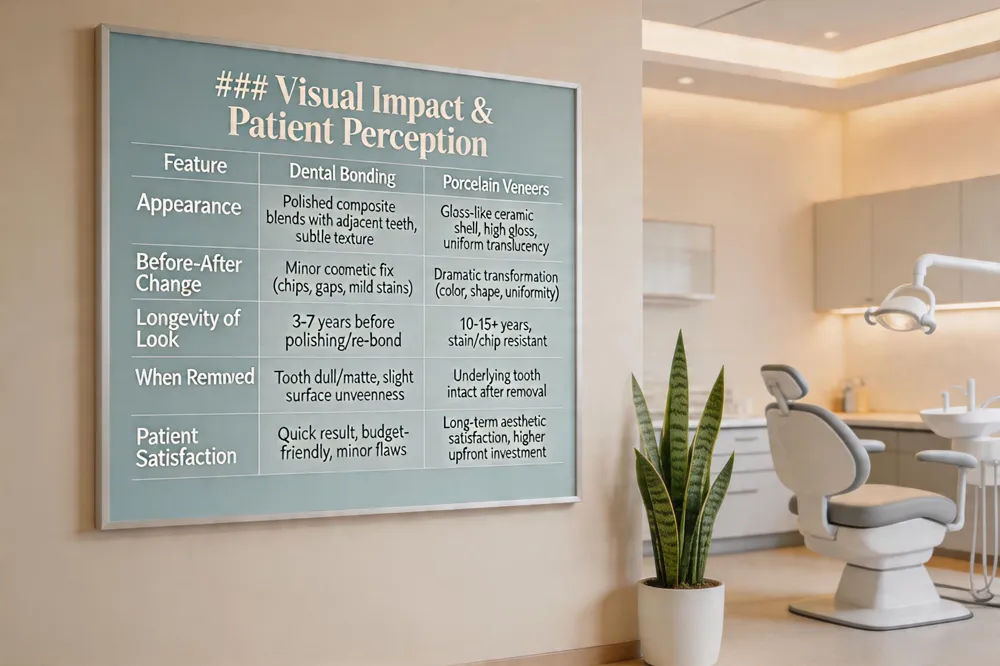 At Veenstra Family Dental we showcase extensive before‑and‑after photo galleries for both dental bonding and porcelain veneers. Bonding pictures illustrate quick, single‑visit fixes for chips, gaps or mild stains, with a natural‑look finish that blends into the surrounding teeth. Veneer photos display a more dramatic change—thicker, glass‑like shells that provide uniform color, translucency and high gloss. The translucency of porcelain veneers mimics natural enamel, giving a brighter, more radiant smile, while composite bonding, though polished, may appear slightly less glossy and show subtle texture.
Aesthetic, veneers maintain their appearance for 10‑15 years or longer, resisting stains and chipping; bonding typically lasts 3‑7 years before polishing or replacement is needed. When bonding is removed, the tooth may look dull or matte, with a slightly uneven surface and a faint loss of luster compared with the original enamel. Reviewing side‑by‑side images helps patients decide which level of durability and visual impact best matches their smile goals. Both options look best with brushing, flossing and dental check‑ups, which preserve the shine and prevent premature wear.
Frequently Asked Patient Questions
FAQ Summary
| Question | Brief Answer |
|---|---|
| What are porcelain veneers? | Thin custom ceramic shells covering front of tooth; 10‑15 yr lifespan; $990‑$2,200 per tooth. |
| Best cosmetic dental options? | Whitening (color), veneers (shape/color), clear aligners (alignment), bonding (minor repairs), implants (missing teeth). |
| What is the best cosmetic procedure for teeth? | Depends on issue: veneers for versatile correction; bonding for fast, affordable fixes. |
| Can bonding be used on slightly crooked teeth? | Yes, mild rotations or small overlaps can be reshaped; severe misalignment needs orthodontics. |
| Can bonding close gaps? | Small gaps ≤ 2 mm can be closed; larger gaps may need veneers or orthodontics. |
| Dental bonding near me? | Veenstra Family Dental, Midland Park, NJ – same‑day results, call (201) 555‑1234. |
| Cosmetic dental treatment near me? | Veenstra offers whitening, veneers, Invisalign®, smile makeovers, etc. |
| What is the 4‑8‑10 rule for veneers? | 4 = central incisors only, 8 = all front teeth (canine‑to‑canine), 10 = extend to first premolars for broader makeover. |
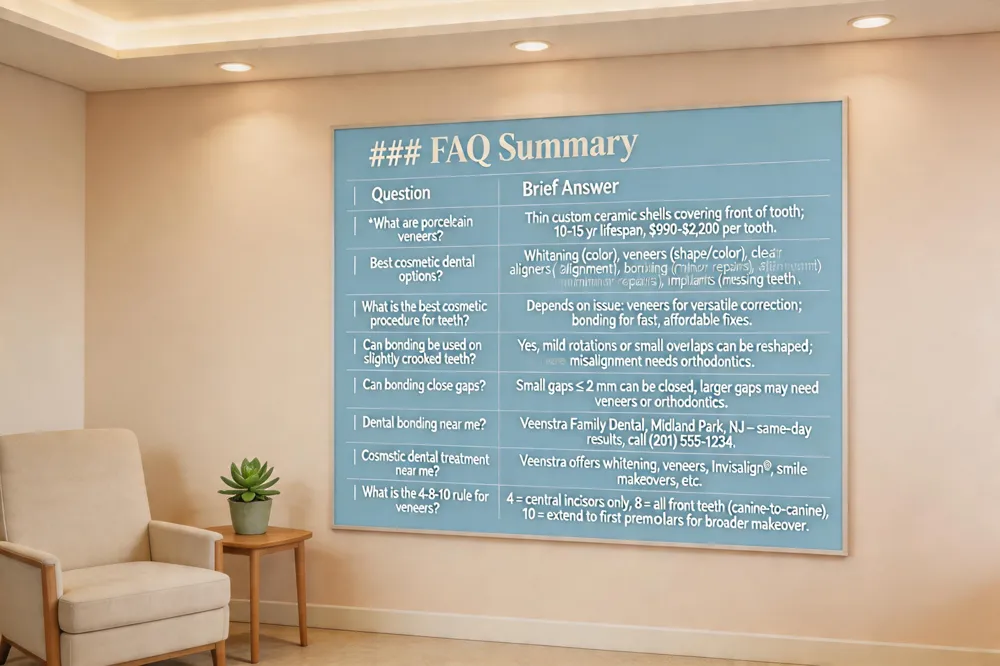 Cosmetic teeth veneers – Porcelain veneers are thin, custom‑made shells that mask chips, cracks, stains, gaps, or misshapen teeth. At Veenstra Family Dental we use high‑quality ceramic and digital imaging for a natural, durable smile lasting 10‑15 years. Costs range $990‑$2,200 per tooth.
Best cosmetic dental options – Quick whitening brightens color; veneers correct chips, gaps, severe stains; clear aligners discreetly straighten teeth; composite bonding repairs minor chips, cracks, or gaps in one visit; implants replace missing teeth.
What is the best cosmetic procedure for teeth? – Veneers are most versatile for discoloration, shape, and spacing, while bonding offers a fast, affordable fix for small imperfections. A personalized consult determines the optimal plan.
Can you get composite bonding on slightly crooked teeth? – Yes, mild rotations or small overlaps can be reshaped with resin in a single visit, but severe misalignment requires orthodontics.
Can you get composite bonding if you have gaps in your teeth? – Small gaps (up to 2 mm) can be closed with bonding; larger spacing may need veneers or orthodontic treatment.
Dental bonding near me – Veenstra Family Dental in Midland Park, NJ provides quick, minimally invasive bonding with same‑day results. Call (201) 555‑1234.
Cosmetic dental treatment near me – Our office offers whitening, veneers, Invisalign®, and smile makeovers using modern technology in a friendly, family‑focused setting.
What is the 4‑8‑10 rule for veneers? – It guides veneers placement: 4 for central incisors only, 8 for all front teeth (canine to canine), 10 when extending to first premolars for a broader makeover.
Specialty, Insurance and Final Guidance
Specialty, Insurance & Next Steps
| Topic | Details |
|---|---|
| Is cosmetic dentistry a specialty? | Not ADA‑recognized; practiced by general dentists with aesthetic training. Closest specialty is prosthodontics. |
| Cost of bonding vs. veneers (Veenstra) | Bonding $100‑$400 per tooth; Porcelain veneers $800‑$2,500 per tooth. |
| Insurance coverage | Neither typically covered; bonding may receive partial reimbursement if it restores function. |
| Financing & Treatment Planning | Veenstra offers personalized plans, financing options, and complimentary consultation. |
| Next steps for patients | Schedule a consultation → Discuss goals → Receive treatment plan & financing options → Proceed with chosen procedure. |
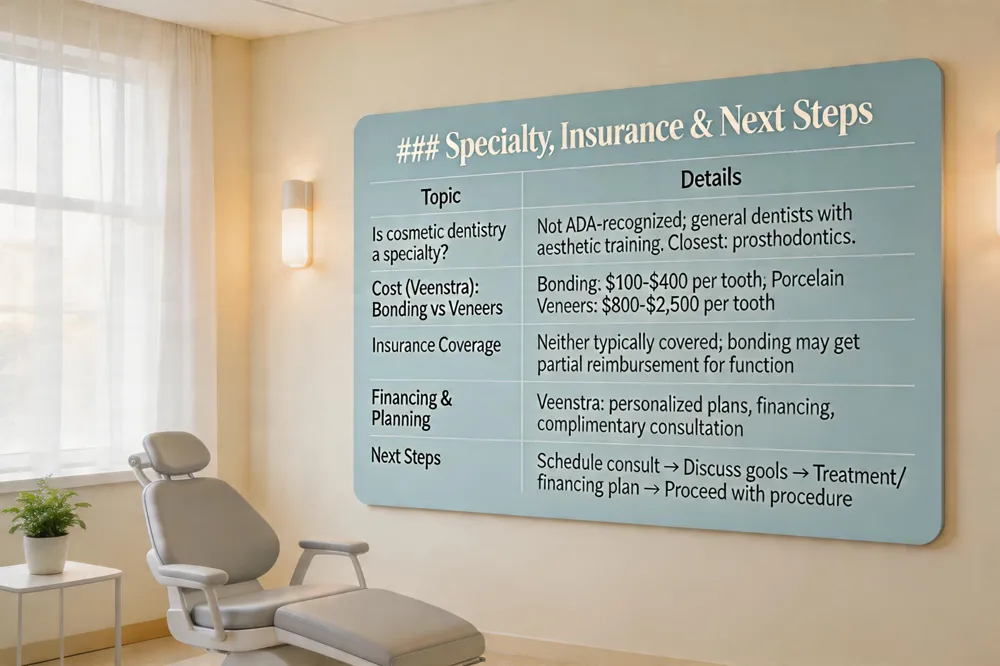 Is cosmetic dentistry a specialty? The American Dental Association does not recognize cosmetic dentistry as an official specialty; it is a practice focus pursued by general dentists with aesthetic training. Prosthodontics is the closest ADA‑recognized specialty.
Cosmetic dental options cost: At Veenstra Family Dental, composite bonding ranges $100‑$400 per tooth, while porcelain veneers cost $800‑$2,500 per tooth. Both are not covered by insurance, though bonding may be partially reimbursed if it restores function.
Next steps: Schedule a consultation, discuss your goals, and receive a treatment plan and financing options.
Final Thoughts
Choosing between dental bonding and porcelain veneers depends on your specific smile goals, budget, and how much tooth structure you’re willing to alter. Bonding offers an affordable fix for small chips, gaps, or mild stains, lasting 3‑7 years with proper care. Veneers provide a longer‑lasting, stain‑resistant solution for more pronounced imperfections, but require enamel removal, multiple visits, and a higher cost. Our team at Veenstra Family Dental will evaluate your needs, discuss these factors, and design a plan—schedule your consultation today to achieve the smile you deserve.