Understanding Dental Restorations
Restorative dentistry focuses on repairing damaged teeth while preserving as much natural structure as possible. Indirect restorations—such as inlays, onlays and crowns—are crafted in a laboratory and bonded to the tooth in a second visit. Inlays and onlays fit within or cover only the cusps, offering a conservative alternative to full‑coverage crowns when decay is moderate and healthy tooth remains. This minimally invasive approach maintains strength, reduces sensitivity, and supports long‑term oral health for patients of all ages.
When Inlays Are the Ideal Choice
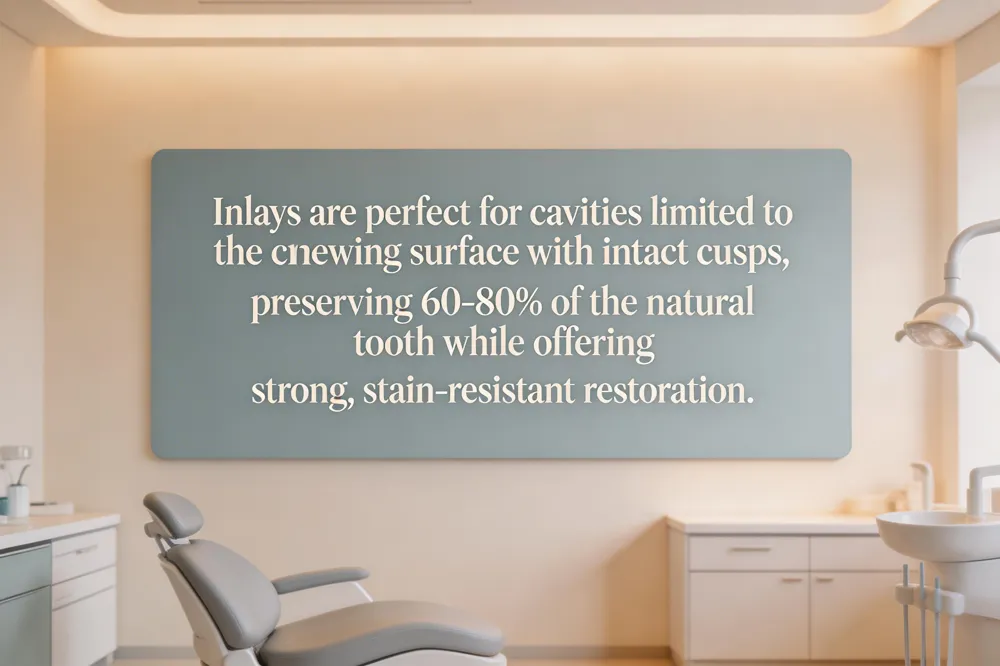 Inlays are the go‑to restoration when decay is confined to the chewing surface and the cusps remain intact. By preserving the healthy tooth tissue, they keep the tooth’s natural strength while offering a precise, stain‑resistant fit. Common materials include porcelain, composite resin, and gold, each providing excellent aesthetics and durability.
What does an inlay cost?
The price of a dental inlay typically falls between $650 and $1,200 per tooth, averaging around $900. Material choice (porcelain, composite, gold) influences the final amount, and most insurance plans cover a portion, leaving an out‑of‑pocket cost of roughly $40–$100 for porcelain or composite. Veenstra Family Dental provides a personalized estimate during the initial consult and can discuss financing options.
When would a dentist indicate an inlay instead of a filling?
An inlay is recommended when a cavity is too large or the tooth structure too weakened for a direct filling, or when a previous filling has repeatedly failed. It offers lab‑crafted strength, preserves more healthy tooth, and avoids the extensive reduction required for a crown.
What are the disadvantages of inlays?
They require at least two appointments, are more expensive than direct fillings, and may involve removal of more healthy tooth than a simple filling, potentially increasing temporary sensitivity. Some materials (e.g., composite) may wear faster than crowns.
Inlay vs onlay
An inlay fits entirely within the occlusal surface, restoring only the area between cusps. An onlay extends over one or more cusps, acting as a “partial crown.” Both are custom‑made from porcelain, ceramic, gold, or composite, but onlays are chosen when decay reaches the cusps while still preserving more tooth structure than a full crown.
Inlays vs. Crowns: Clinical Decision Factors
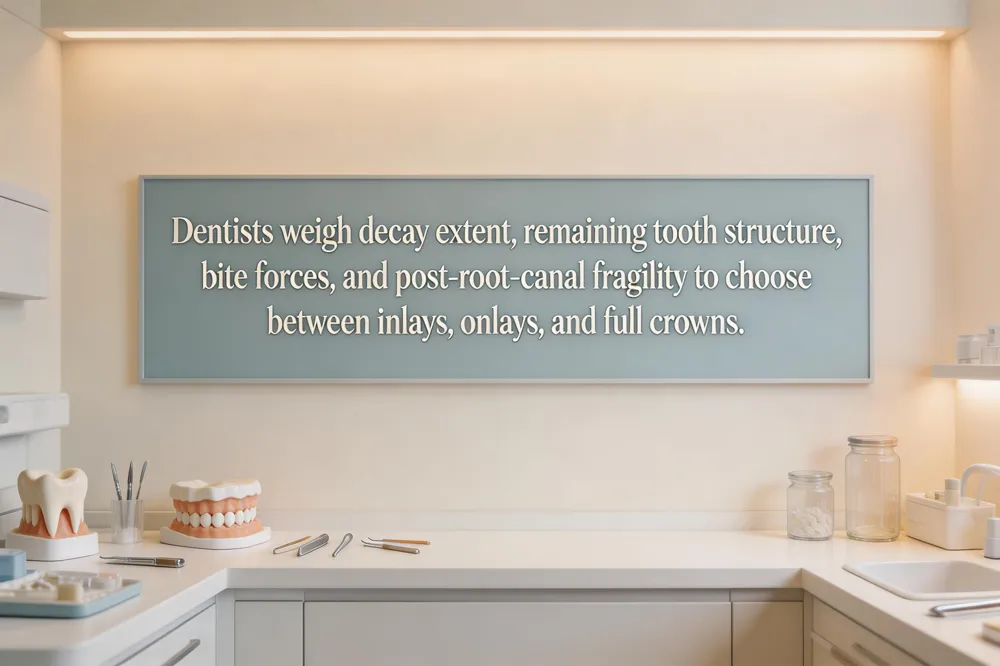 When deciding between an inlay (or onlay) and a full crown, dentists first assess the extent of decay or structural loss. Moderate cavities confined to the chewing surface, with healthy cusps intact, are ideal for an inlay because it preserves 60‑80 % of the natural tooth. Extensive decay, large fractures, or loss of more than half the tooth structure usually require a crown for full coverage and strength.
After a root‑canal treatment the tooth is often more fragile. If only one or two cusps are affected and the surrounding walls remain strong, an onlay can protect the tooth while conserving structure. When the tooth has a large filling, a crack extending beyond the cusps, or significant enamel loss, a crown is recommended to provide comprehensive reinforcement.
Bite forces and bruxism also influence the choice. Patients who grind their teeth generate higher occlusal loads; crowns, especially those made of zirconia or metal, distribute these forces more evenly, reducing fracture risk. For patients with normal bite forces, an onlay offers a conservative, aesthetic solution.
Onlay vs crown after root canal – After a root‑canal, the amount of healthy structure determines the restoration. Limited damage may be treated with an onlay; extensive loss calls for a crown.
Onlay vs crown vs filling – Fillings suit small cavities; onlays cover one or more cusps for moderate damage; crowns encase the entire tooth for severe decay or fractures.
Onlay vs crown indications – Onlays are indicated for localized cusp damage with sufficient healthy tooth; crowns are indicated when more than half the tooth is missing or severely weakened.
Onlay vs crown pros and cons – Onlays preserve more natural tooth and reduce sensitivity but may be less durable for heavily compromised teeth. Crowns provide full protection but require more tooth reduction.
Comparing Inlays, Onlays, and Crowns
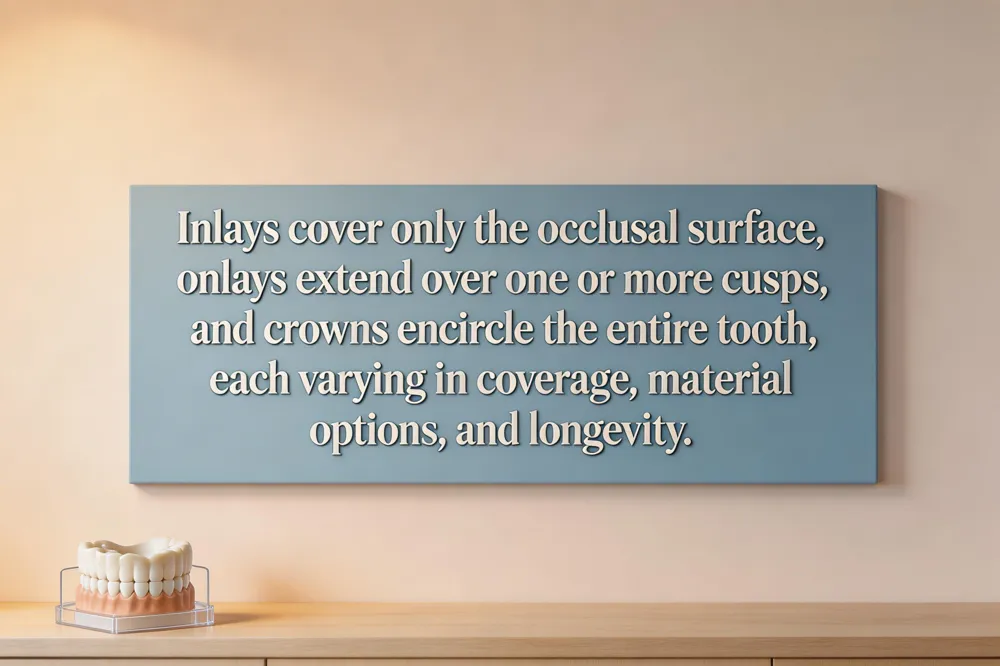 When choosing a restoration, the key difference is partial coverage (inlays, onlays) versus full coverage (crowns). Inlays fit within the chewing surface, preserving most of the natural tooth, while onlays extend over one or more cusps and act as a "partial crown." Crowns encircle the entire visible tooth, providing maximum strength for extensively damaged teeth.
Material options and aesthetics include porcelain, ceramic, composite resin, gold alloy, and zirconia. Tooth‑colored ceramics and composite offer seamless color‑matching, while gold provides exceptional durability. Modern CAD/CAM technology allows precise, same‑day fabrication for all three restoration types, ensuring a comfortable, welcoming experience for patients of any age.
Onlay vs crown longevity Both onlays and full‑coverage crowns typically last 10‑15 years with good oral hygiene. Onlays, preserving more natural structure, often achieve 12‑18 years, especially in porcelain or gold. Crowns may have a slight edge in heavily stressed molars because they distribute bite forces over a larger area. Longevity depends on material, bite forces, and proper sealing.
Onlay vs crown cost An inlay generally costs $650‑$1,200 per tooth (average $900 after insurance), while a full crown ranges $1,100‑$1,650. The price reflects the amount of tooth reduction and material used. Both procedures are often partially covered by dental insurance. Choosing the right option balances the extent of damage, desired durability, and out‑of‑pocket costs.
Cost Considerations and Insurance
 At Veenstra Family Dental we believe every patient deserves clear pricing and flexible payment options. A single inlay typically ranges from $250 to $1,500, while onlays fall between $350 and $1,500. Full‑coverage crowns cost $500‑$2,000 depending on material (porcelain, zirconia, or metal). Front‑tooth restorations such as porcelain veneers or crowns run $800‑$2,500 per tooth, and composite bonding is a budget‑friendly $100‑$400 alternative. Insurance plans often classify inlays as a premium, custom‑fabricated restoration rather than a standard filling, so they may be deemed “non‑essential” and denied coverage. Most plans prioritize the least expensive clinically acceptable option, which is usually a direct filling, even though an inlay can last longer and reduce future work. Veenstra Family Dental works with major carriers and offers CareCredit financing, in plans, and interest‑free promotional periods to bridge any coverage gaps. Our team tailors a treatment plan that balances durability, aesthetics, and cost, ensuring patients of all ages receive the most appropriate, affordable care in a warm, modern setting.
Patient Experience and Aftercare
 At Veenstra Family Dental we treat every indirect restoration—whether an inlay , an onlay , or a crown —as a two‑visit, patient‑focused process. First, the dentist removes decay and prepares a precise cavity, then takes a digital impression for a lab‑fabricated restoration. A temporary filling protects the tooth while the custom piece is milled or cast. At the second visit the restoration is bonded with modern resin cement, adjusted for a comfortable bite, and polished for a natural look.
Is tooth restoration painful? Most patients feel only mild, temporary sensitivity to hot, cold, or pressure that fades within a few days. Persistent or severe pain may indicate pulp inflammation and should be evaluated promptly.
Dental restoration procedure repairs damaged tooth structure by removing decay, preparing the tooth, and placing a custom‑made filling, inlay, onlay, or crown using bonding agents. Advanced CAD/CAM technology often allows same‑day placement.
Teeth restoration meaning restores function and aesthetics to a decayed, broken, or missing tooth, preventing further deterioration and improving oral health.
Maintenance for longevity includes brushing twice daily, flossing, regular six‑month check‑ups, and avoiding hard or sticky foods. Patients who grind their teeth should wear a nightguard to protect the restoration.
Frequently Asked Questions
 Welcome to Veenstra Family Dental, where gentle, modern care helps you feel confident about your smile and supports lasting oral health.
What is the most feared dental procedure? The most feared procedure is the root canal, because it involves removing infected nerve tissue. Modern Veenstra uses effective anesthesia, nitrous‑oxide sedation, and precise techniques to make it virtually painless.
What is the 3-3-3 rule for teeth? The 3‑3‑3 rule suggests brushing three times a day for three minutes and waiting three hours before bedtime. Evidence‑based guidelines recommend brushing twice daily for two minutes, daily flossing, and regular check‑ups.
What is the cheapest way to restore teeth? The least expensive option is tooth contouring (enamel reshaping) at $50‑$300 per tooth. Next‑lowest is bonding ($300‑$600), followed by composite fillings ($150‑$450). For extensive loss, dentures are budget‑friendly.
Your Path to a Healthy Smile
At Veenstra Family Dental we begin every case with a personalized evaluation of your tooth structure, using digital imaging and CAD/CAM technology to map decay and assess how much healthy tissue remains. This modern, minimally invasive approach lets us decide whether an inlay, onlay or crown best fits your needs. Our family‑focused team creates a welcoming, compassionate environment for patients of all ages, ensuring each restoration blends durability with natural aesthetics and long‑term oral health for every smile in confidence.