Introduction to Laser Dentistry
Laser dentistry uses focused light energy instead of drills or scalpels to cut, reshape, or disinfect oral tissues. Patients enjoy virtually painless treatment, less bleeding, faster healing, and often no need for local anesthesia, which reduces anxiety. The technology is FDA‑approved, cleared by the American Dental Association, and safe when performed by trained clinicians wearing protective eyewear. This modern, minimally invasive approach makes dental care comfortable for all ages.
Laser Dentistry: Benefits, Safety, and Patient Experience
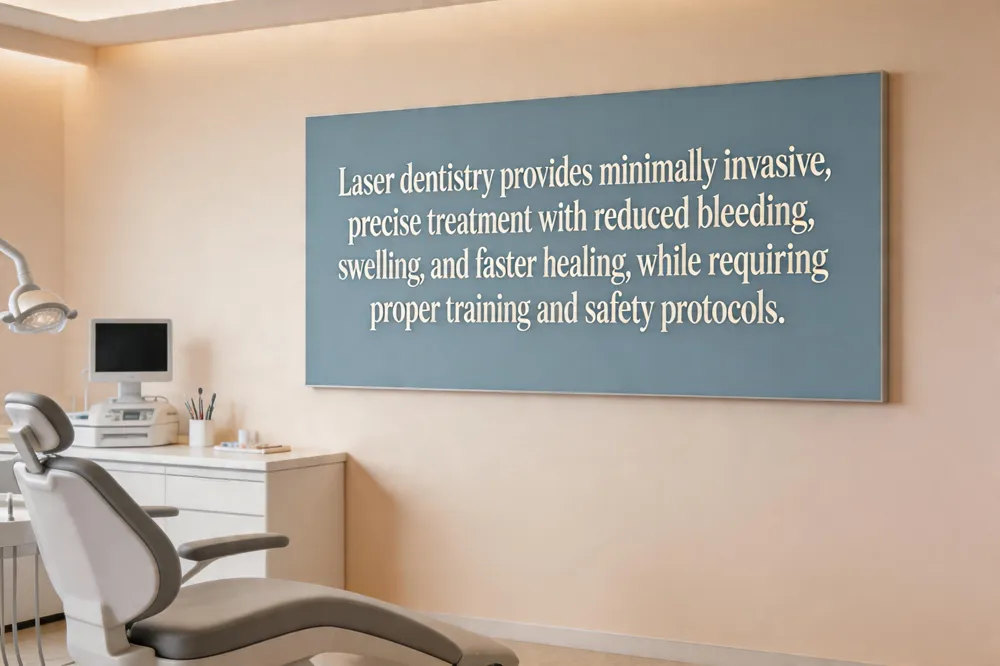 Laser dentistry uses focused light energy to cut or reshape both soft and hard oral tissues with remarkable precision. Because the laser seals blood vessels as it works, patients experience minimal bleeding, reduced swelling, and faster healing compared with traditional drills or scalps. This precision often eliminates the need for local anesthesia, making procedures virtually painless and especially helpful for those with dental anxiety.
Pros and cons of laser dentistry – Benefits include minimally invasive treatment, less pain, quicker recovery, and a lower risk of infection. Lasers are ideal for gum reshaping, cavity removal, periodontal therapy, and cosmetic whitening. Drawbacks are higher equipment costs, which can raise treatment fees, and the fact that not all procedures (large cavities, deep interproximal decay, or work on existing crowns) can be performed with a laser alone. Proper training and protective eyewear are essential for safety.
Disadvantages – The technology is expensive, may increase patient costs, and isn’t suitable for every case. Misuse can damage healthy tissue, and some dentists may still be on the learning curve.
Laser dentistry near me – Veenstra Family Dental in Midland Park, NJ offers state‑of‑the‑art laser services in a warm, family‑focused environment.
Is laser gum treatment painful? – Generally no. Patients feel only a mild tingling or warmth under local anesthesia; post‑procedure soreness is mild and resolves in a few days.
Is laser teeth cleaning necessary? – Not for everyone. Routine scaling is sufficient for most, but laser cleaning can be a gentler, targeted option for periodontal disease, high sensitivity, or anxious patients.
Laser in dentistry PDF – Reliable PDFs are available from the American Dental Association, the National Journal of Maxillofacial Surgery, and the American Association of Endodontists, covering laser science, safety, and clinical protocols.
Gum Contouring with Lasers: Procedure and Recovery
 Laser gum contouring uses a focused dental laser to trim excess gingival tissue with millimeter‑level precision. The laser’s heat seals blood vessels as it cuts, so bleeding is minimal and stitches are rarely needed. A small amount of local anesthetic numbs the area, making the treatment virtually painless.
Recovery is swift: most patients feel comfortable enough for light activities within 2–3 days. Swelling and mild soreness may linger for up to a week; soft, cool foods (yogurt, eggs, pasta) are recommended, and gentle oral hygiene with a soft‑bristled brush and saline rinses helps protect the site.
Initial healing begins within 48 hours, and the gum line typically stabilizes by the end of the first week, with full tissue remodeling by two weeks.
Side effects are mild and temporary—light burning during the procedure, slight post‑operative swelling, occasional tooth sensitivity, or brief discoloration that resolves within 24–48 hours.
Rare risks include over‑contouring, temporary recession, infection if after is ignored, or an allergic reaction to anesthetic.
The tissue removed by laser contouring does not typically regrow, making the aesthetic results permanent in the majority of cases.
Veenstra Family Dental in Midland Park, NJ offers laser gum contouring to patients throughout the New York City area, delivering a painless, precise solution for gummy smiles and uneven gum lines while supporting oral health.
Addressing Receding Gums: Options Beyond Contouring
 Receding gums are a sign that the underlying tissue is lost, not merely excess tissue that can be trimmed. Gum contouring for receding gums reshapes the visible line by removing surplus tissue, but it does not restore the missing gum. For true recession, the cause must be treated and the lost tissue replaced—usually with a graft or the minimally invasive Pinhole® Surgical Technique (PST).
What can be done instead of gum grafting? First, a thorough scaling and root planing removes plaque and reduces inflammation, allowing the existing gum to heal. Regenerative options such as bone grafts or bio‑active membranes rebuild lost bone before soft‑tissue work. For mild uneven recession, laser contouring can smooth the line, and the laser’s cauterizing effect speeds recovery. PST creates tiny entry points to loosen and reposition gum tissue without sutures or donor tissue.
Can laser fix receding gums? Laser therapy improves gum health by removing diseased tissue and stimulating natural healing, but it cannot replace a graft when deep recession exists. It is a valuable adjunct that reduces discomfort and enhances sterility.
What is the new procedure for receding gums? The latest innovation is the Chao Pinhole® Surgical Technique, which repositions gum tissue through a minute pinhole, eliminating incisions, sutures, and the need for graft material.
When is it too late for gum grafting? If severe bone loss, tooth mobility, or extensive root damage has occurred, grafts are unlikely to succeed, and extraction with implant placement may become the preferred solution. Early evaluation and treatment are essential for optimal outcomes.
Cost, Insurance, and Value of Laser Gum Treatments
 Laser gum treatments offer a modern, minimally invasive alternative to traditional surgery, but understanding the cost structure helps patients decide if the investment fits their budget.
Pricing ranges widely: laser‑assisted gum therapy (LANAP) typically costs $2,000‑$8,000 for a full‑mouth case, while laser gum‑contouring runs $300‑$800 per quadrant ($200‑$400 per tooth). Full‑mouth cosmetic contouring can be $1,000‑$3,000, and individual tooth reshaping may be $50‑$350.
Insurance usually covers procedures deemed medically necessary, such as laser treatment for periodontal disease, but cosmetic gum recontouring is often out‑of‑pocket. Many offices, including Veenstra Family Dental, offer financing plans, CareCredit, or in‑house payment options to spread the expense.
Compared with scalpel surgery, laser work reduces bleeding, swelling, and recovery time, which can lower the number of follow‑up visits and indirect costs like missed work. Although the upfront price may appear higher, the faster healing and reduced anesthesia often make laser gum treatments cost‑effective over the long term.
Patients should discuss their specific case with a trained dentist to receive a personalized estimate and determine the best financial pathway.
Practical Guidance: Finding Care and Managing Expectations
 When looking for a laser gum‑contouring specialist, Veenstra Family Dental in Midland Park, NJ offers state‑of‑the‑art laser technology in a warm, family‑focused office that welcomes patients of all ages. Before treatment, the gum line may appear uneven, excessive, or "gummy," covering much of the teeth. During the laser procedure a focused beam gently removes the surplus tissue, reshaping the margin without stitches, heavy bleeding, or vibration. Immediately afterward the gums look smoother and the teeth appear longer; within a few days the result settles into a natural, balanced smile that can enhance veneers or bonding.
For a "gummy smile," laser reshaping (diode‑laser crown lengthening) vaporizes excess tissue while cauterizing blood vessels, giving a quick, virtually painless fix for healthy gums. Patients typically resume normal activities the next day and manage mild swelling with OTC pain relievers.
Post‑procedure, stick to soft foods, avoid spicy or sharp items, and maintain diligent oral hygiene with a soft‑bristled brush and gentle rinses. Regular cleanings keep plaque out of newly shaped areas and support long‑term health.
FAQ highlights: "Laser gum contouring near me" points to Veenstra’s convenient NJ location; "Laser dentistry near me" offers painless gum, whitening, and soft‑tissue care; kissing with active gingivitis can spread bacteria, so treat the inflammation first; and the simple "3‑3‑3" rule calls for three 200‑mg ibuprofen tablets every three hours for up to three days to control pain. Contact Veenstra for a personalized consultation and discover how modern laser dentistry can transform your smile with minimal downtime.
Final Thoughts
Laser gum contouring delivers precise, painless reshaping of excess gum tissue, reducing bleeding, swelling, and recovery time while enhancing smile aesthetics and oral hygiene. When selecting a provider, ensure the dentist holds certified laser training, uses FDA‑cleared equipment, and offers a comfortable, family‑focused environment. Schedule a consultation to discuss your goals, review your oral health, and plan a personalized, minimally invasive treatment that fits your lifestyle.