Welcome to Gentle, Pain‑Free Dental Care
Pain‑free dentistry combines modern anesthesia, sedation and minimally invasive tools so every visit feels comfortable. At Veenstra Family Dental we tailor this approach for patients of all ages, creating a warm, family‑focused environment where children, teens and adults alike feel at ease. Our office uses laser‑assisted decay removal, computer‑controlled anesthetic delivery (The Wand), digital X‑rays and intra‑oral scanners to protect healthy tooth structure and eliminate the vibration of traditional drills. Nitrous oxide, oral sedatives and optional IV sedation further reduce anxiety and the gag reflex. By pairing cutting‑edge technology with soothing music, soft lighting and clear communication, we ensure each restorative procedure—especially fillings—remains gentle, efficient and virtually pain‑free.
Laser Dentistry: Precision with Minimal Discomfort
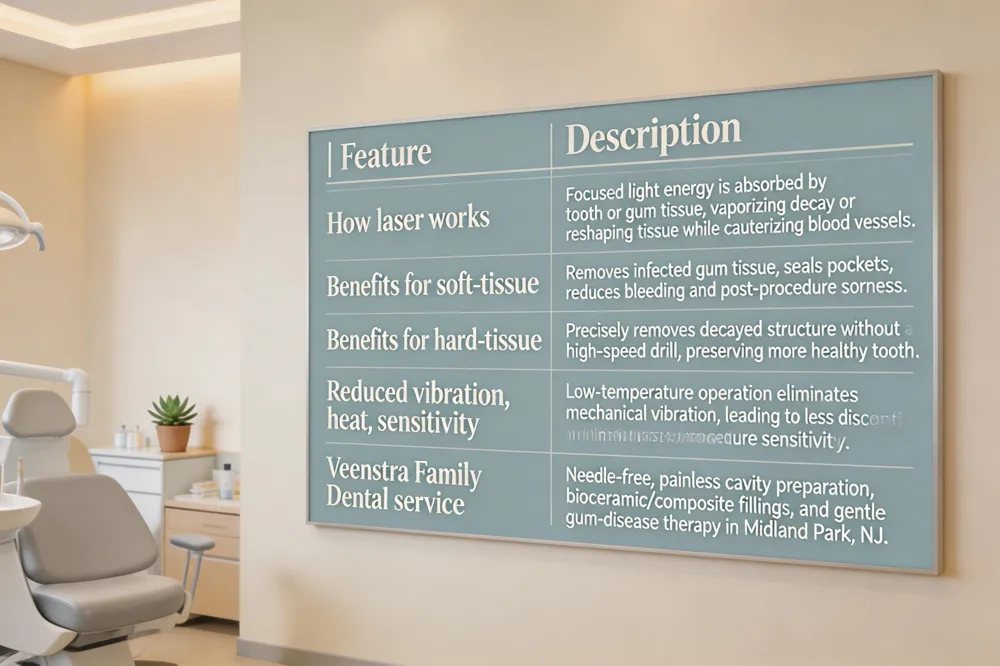
| Feature | Description |
|---|---|
| How laser works | Focused light energy is absorbed by tooth or gum tissue, vaporizing decay or reshaping tissue while cauterizing blood vessels. |
| Benefits for soft‑tissue | Removes infected gum tissue, seals pockets, reduces bleeding and post‑procedure soreness. |
| Benefits for hard‑tissue | Precisely removes decayed structure without a high‑speed drill, preserving more healthy tooth. |
| Reduced vibration, heat, sensitivity | Low‑temperature operation eliminates mechanical vibration, leading to less discomfort and minimal post‑procedure sensitivity. |
| Veenstra Family Dental service | Needle‑free, painless cavity preparation, bioceramic/composite fillings, and gentle gum‑disease therapy in Midland Park, NJ. |
 Laser dentistry delivers focused light energy that can cut, reshape, or remove both soft‑tissue and hard‑tissue with pinpoint accuracy. By targeting only the diseased area, the laser eliminates the need for traditional drilling, reducing vibration, heat, and the loud whine that often triggers anxiety.
How laser technology works – A calibrated beam of light is absorbed by the tooth or gum tissue, vaporizing decay or reshaping gum lines while simultaneously cauterizing blood vessels, which limits bleeding and promotes faster healing.
Benefits for soft‑tissue and hard‑tissue treatment – For gum disease, the laser removes infected tissue and seals the pocket, decreasing post‑procedure soreness. For cavities, it precisely removes decayed structure without the pressure of a high‑speed drill, preserving more healthy tooth.
laser‑assisted fillings and gum‑disease therapy at Veenstra – At Veenstra Family Dental in Midland Park, NJ, we use lasers for painless cavity preparation, bioceramic or composite fillings, and gentle gum‑disease therapy. The result is a needle‑free, comfortable experience for patients of all ages, especially those with dental anxiety.
Reduced vibration, heat, and post‑procedure sensitivity – Because the laser works at low temperatures and without mechanical vibration, patients report less discomfort during and after treatment, often needing only over‑the‑counter pain relievers.
FAQ
Laser dentistry near me: If you search for “laser dentistry near me,” you’ll find Veenstra Family Dental offering modern, pain‑free laser services that minimize discomfort and speed recovery.
Laser dentistry: This technology uses focused light to treat decay, gum disease, and even whiten teeth, providing a quieter, quieter, and and deposits especially needle conventional filling reducing with needle for techniques fillers.
Managing Post‑Filling Sensitivity and Discomfort
| Issue | Typical cause | Quick relief |
|---|---|---|
| Mild ache after a week | Temporary pulp inflammation from drilling or a high‑spot bite. | Ibuprofen/acetaminophen, warm salt‑water rinse, avoid extreme temps. |
| Throbbing pain | High‑spot bite or lingering pulp irritation; rare allergic reaction. | Bite adjustment, OTC anti‑inflammatories, monitor for >1 wk. |
| Nerve pain | Deep decay or trauma irritates nerve (reversible/irreversible pulpitis). | Desensitizing agents, possible root‑canal if persistent. |
| Jaw pain | Prolonged mouth opening or high‑point restoration straining TMJ. | Warm compress, gentle stretching, OTC ibuprofen; follow‑up if >1 wk. |
| General relief strategies | Inflammation, temperature sensitivity, chewing pressure. | Cold compress 15 min intervals, chew opposite side, keep to ice‑cold only. |
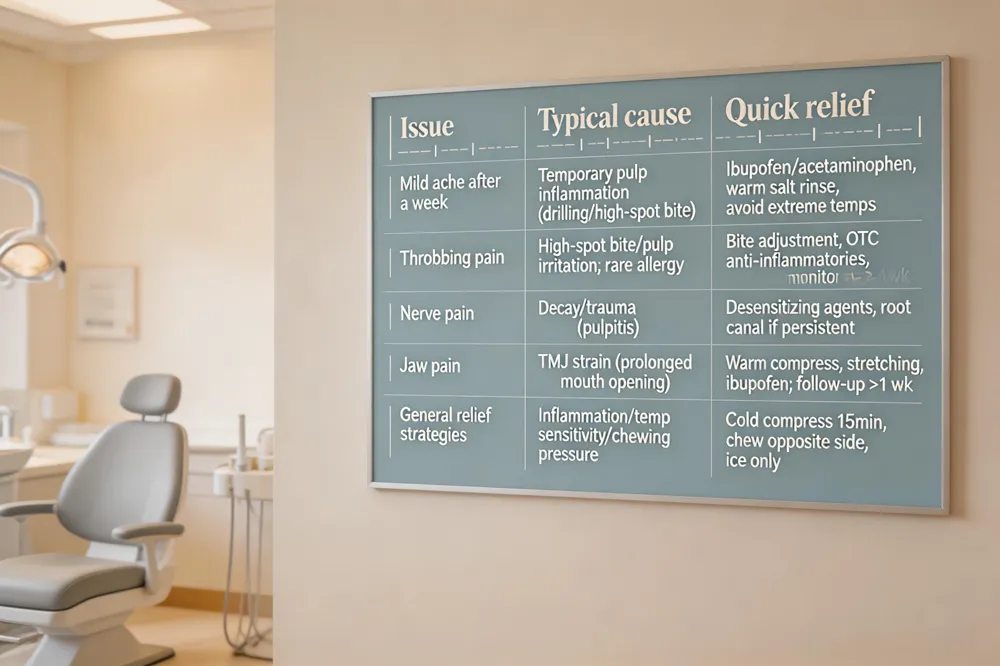 After a recent filling, many patients wonder why the tooth still hurts. Below are the most common reasons and practical relief strategies, presented in a friendly, easy‑to‑read format.
Why does my tooth filling hurt after a week? Mild ache is usually the result of temporary pulp inflammation caused by the drilling and removal of decay. A “high‑spot” bite—where the new restoration contacts the opposing tooth slightly early—can also create pressure‑induced pain. Metal‑based fillings conduct temperature changes quickly, leading to brief hot‑or‑cold spikes. Most discomfort fades within one to two weeks; persistent or worsening pain warrants a check‑up for bite adjustment or material review.
Throbbing pain after cavity filling A throbbing sensation often signals a high‑spot or lingering pulp irritation. In rare cases, an allergic reaction to the filling material may be involved. The pain typically subsides as the tooth settles, but if it lasts beyond a week, is severe, or is accompanied by swelling or fever, contact your dentist promptly for bite smoothing or a short course of anti‑inflammatories.
Nerve pain after cavity filling Deep decay or trauma during the procedure can irritate the nerve, producing sharp or lingering sensitivity. Most cases resolve within a few weeks, but persistent sharp pain may indicate reversible or irreversible pulpitis, requiring adjustment, desensitizing agents, or, in extreme cases, root‑canal therapy.
Jaw pain after cavity filling A high‑point restoration or prolonged mouth opening can strain the jaw and TMJ, causing soreness or stiffness. Gentle stretching, warm compresses, and OTC ibuprofen usually help. If pain persists past a week or includes clicking or limited opening, a follow‑up is needed.
How to relieve tooth pain after filling Take ibuprofen or acetaminophen as directed, rinse with warm salt water, avoid extreme temperatures, chew on the opposite side, and apply a cold compress for 15‑minute intervals. If pain continues beyond two days or worsens, schedule a dental evaluation. Modern techniques such as laser preparation, computer‑controlled anesthesia, and biocompatible composites further reduce post‑procedure sensitivity, making a quicker and more comfortable recovery.
Long‑Term Care: When Fillings Cause Pain Years Later
| Problem | Why it happens | Prevention / Treatment |
|---|---|---|
| Wear or tiny cracks in filling | Normal occlusal forces, grinding, or material fatigue. | Regular check‑ups, night guard for bruxism, early adjustment. |
| High‑spot bite | Restoration slightly higher than opposing tooth. | Bite adjustment during routine visit. |
| Loose or marginal decay | Bacteria seep at filling edges. | Digital imaging to detect early decay, replace marginal filling. |
| Pulp inflammation (pulpitis) | Chronic irritation from high‑spot or decay. | Desensitizing agents, possible root‑canal if irreversible. |
| Patient‑focused care at Veenstra | Combines laser‑assisted techniques, digital imaging, and gentle anesthesia for quick diagnosis and minimally invasive treatment. |
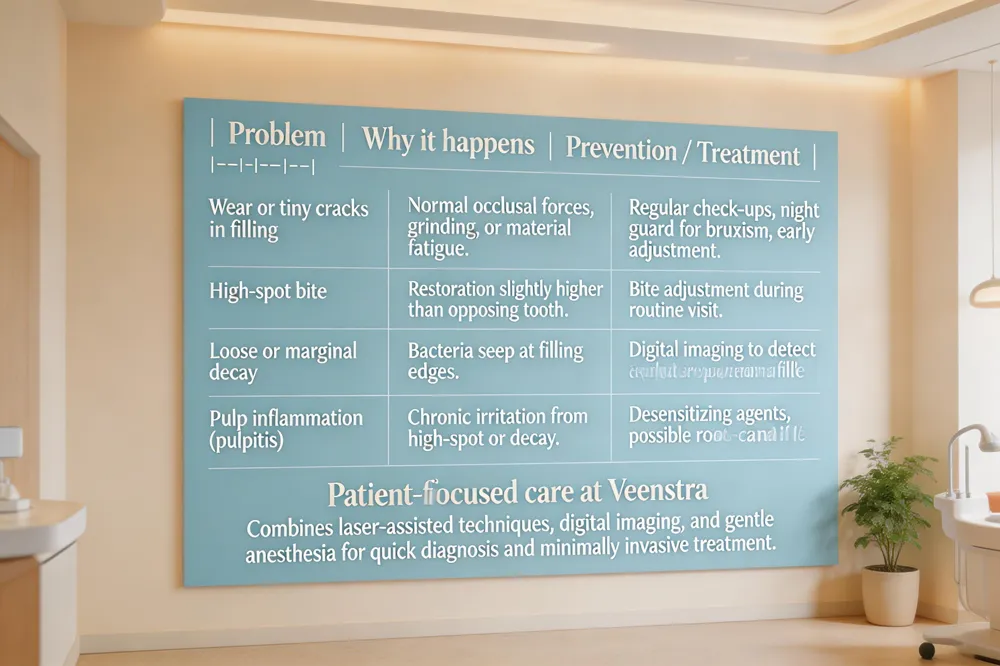 Modern dental restorations are built to last, but over time they can develop issues that cause discomfort. Wearing down or tiny cracks in a filling can let bacteria seep in, leading to decay around the margins and irritation of the pulp. An uneven bite—often called a “high‑spot”—places extra pressure on the restored tooth, while habits such as grinding or clenching can accelerate wear. These factors may result in sensitivity to hot, cold, or chewing and, in some cases, progressing to pulp inflammation that needs further treatment.
Regular check‑ups are essential. During a routine visit the dentist can spot early wear, detect new decay, and adjust the bite before pain becomes severe. If a filling continues to hurt months after placement, the cause is usually a high‑point bite, a loose restoration, or lingering decay—all of which can be corrected with a simple adjustment or replacement. When pain worsens, it may signal pulpitis or an emerging infection that could require a root canal. At Veenstra Family Dental, we combine digital imaging, laser‑assisted techniques, and gentle anesthesia to diagnose and treat these problems quickly, ensuring your smile stays comfortable and healthy for years to come.
Sedation and Anesthesia Options for a Pain‑Free Experience
| Technique | How it works | Benefits |
|---|---|---|
| Topical anesthetic gel | Numbs gum surface before injection. | Reduces needle sting, comfortable first step. |
| Computer‑controlled injection (The Wand) | Delivers local anesthetic slowly and precisely. | Virtually painless injection, less anxiety. |
| Nitrous oxide (laughing gas) | Inhaled gas relaxes patient while staying conscious. | Quick onset, easy recovery, minimal side effects. |
| Oral sedatives | Medication taken prior to appointment. | Decreases overall anxiety, useful for moderate cases. |
| IV sedation | Direct infusion for deep relaxation. | Provides profound anxiety control, monitored by staff. |
| Veenstra amenities | Warm blankets, music, noise‑canceling headphones. | Enhances overall comfort and reduces perceived pain. |
| Insurance coverage | Varies; sedation for medically necessary procedures may be covered, routine sedation often out‑of‑pocket. | Check with insurer before treatment. |
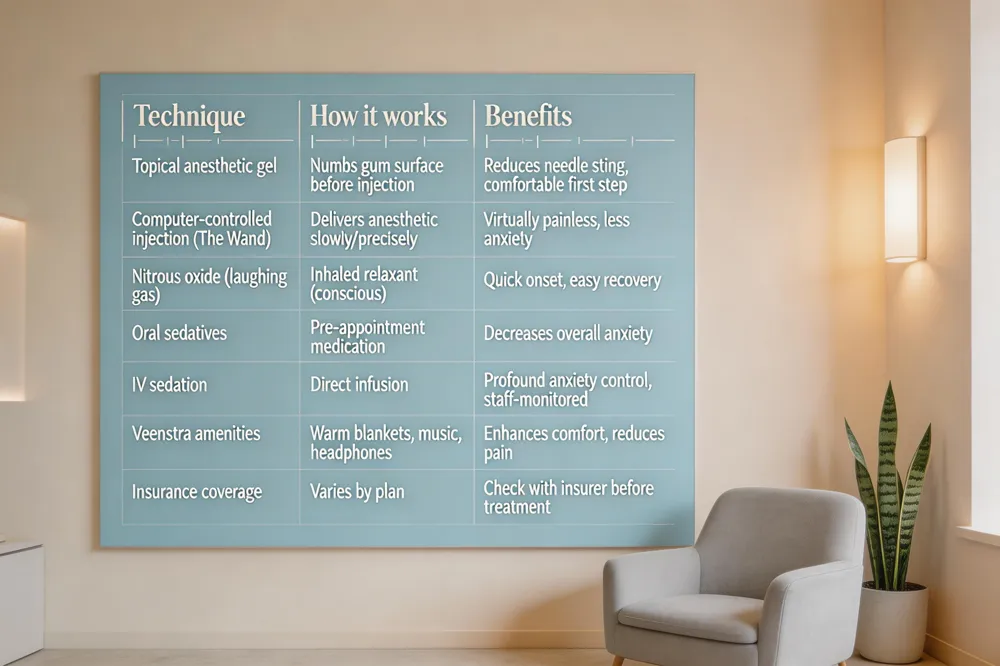 Modern pain‑free dentistry combines gentle anesthesia, advanced delivery systems, and soothing amenities. First, a topical anesthetic gel numbs the gum surface before a local anesthetic injection, and computer‑controlled devices like The Wand deliver the medication slowly for a virtually painless sting. For anxious patients, nitrous oxide (laughing gas), oral sedatives, or IV sedation calm nerves while you stay conscious and comfortable. Veenstra Family Dental enhances the experience with warm blankets, music, and noise‑canceling headphones.
Pain free dentistry near me – At Veenstra in Midland Park, NJ we use CO₂ lasers, CEREC crowns, and digital imaging to keep procedures quick, quiet, and virtually pain‑free.
How to not feel pain during a filling? – Apply topical gel, use laser‑assisted decay removal when possible, and offer nitrous oxide or oral/IV sedation. Communicate any pressure immediately; the dentist can adjust dosing or add a supplemental dose.
What is the most painless dental procedure? – Routine cleanings with digital X‑rays and laser gum treatments are the least invasive, requiring no drilling and only gentle scaling.
Does insurance cover painless dentistry? – Coverage varies; sedation for medically necessary procedures (e.g., severe anxiety) may be reimbursed, but routine sedation often is out‑of‑pocket. Verify with your insurer before treatment.
Patient Resources and Frequently Asked Questions
| Question | Answer |
|---|---|
| Dentist near me | Veenstra Family Dental, Midland Park, NJ – (201) 447‑5555, online booking available. |
| Can seniors get free dentures? | Yes – Medicaid (in participating states), Dental Lifeline Network, dental schools, and many Medicare Advantage plans offer free dentures; we assist with eligibility. |
| 50‑40‑30 rule | Upper front tooth vertical contact proportions: 50 % between centrals, 40 % between central and lateral, 30 % between lateral and canine. |
| 3‑3‑3 rule | Brush 3 times a day for 3 minutes, replace brush every 3 months, see dentist every 3 months. |
| Additional resources | Laser fillings, CEREC crowns, 3‑D imaging, gentle anesthesia – all available at Veenstra Family Dental. |
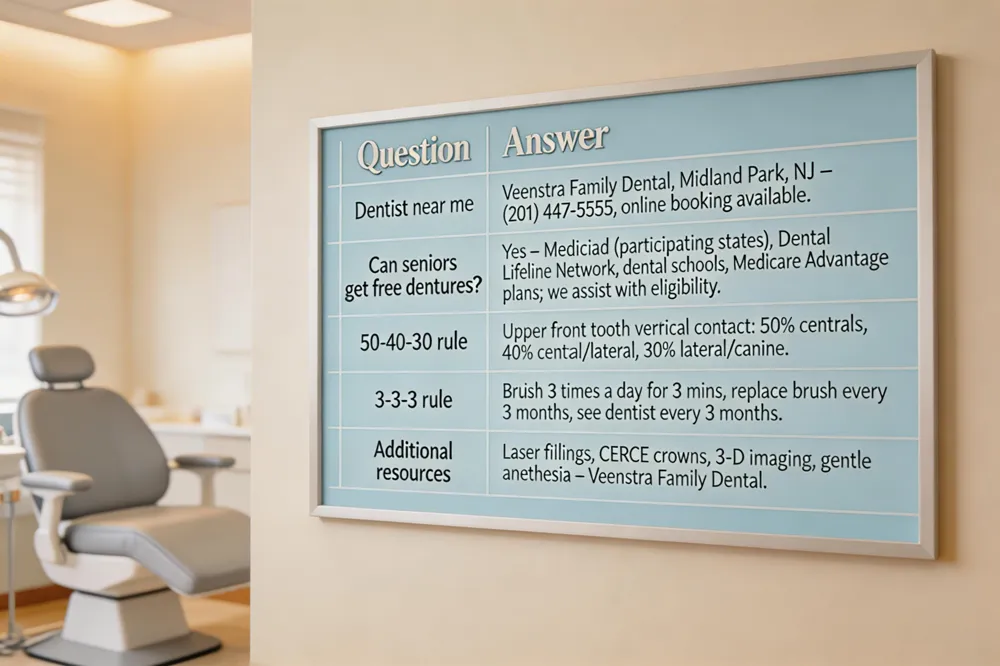 At Veenstra Family Dental we blend gentle, modern technology with a welcoming environment for care.
Dentist near me – Veenstra Family Dental in Midland Park, NJ serves Bergen County. Dr. Caravello offers laser fillings, CEREC crowns and 3‑D imaging. Call (201) 447‑5555 or book online.
Can seniors get free dentures? – Yes. Medicaid (in participating states), Dental Lifeline Network, dental schools and many Medicare Advantage plans offer free dentures. We help with eligibility and paperwork.
What is the 50‑40‑30 rule? – It sets vertical contact proportions of the upper front teeth: 50 % between centrals, 40 % between central and lateral, 30 % between lateral and canine for a balanced smile.
What is the 3‑3‑3 rule? – Brush three times daily for three minutes, replace brush every three months, and see the dentist every three months.
Your Path to Comfortable Dental Health
At Veenstra Family Dental we blend the latest pain‑free technologies with a warm, personalized atmosphere for patients of every age. Modern laser dentistry, computer‑controlled anesthetic delivery (The Wand), nitrous‑oxide and oral sedation, and advanced composite‑ resin fillings eliminate the sting of needles, the vibration of drills, and post‑procedure soreness. Our team walks you through each step, offers soothing music, blankets and visual distractions, and tailors sedation to your comfort level. Experience a seamless, gentle restoration that protects your smile and reduces anxiety. Call today to schedule your appointment and discover how our commitment to ongoing comfort makes every visit a positive, stress‑free experience. We look forward to welcoming you soon.