Welcome to Restorative Solutions
At Veenstra Family Dental we combine family‑focused care with state‑of‑the‑art technology to deliver personalized restorative solutions for patients of every age. Our welcoming office in Midland Park, NJ, uses digital imaging, CAD/CAM milling and same‑day CEREC crowns to create natural‑looking restorations quickly and comfortably. Whether you need a simple composite filling, a custom‑crafted crown, a bridge, an implant, or TMJ therapy, our team tailors each treatment to preserve as much healthy tooth structure as possible while restoring function and smile aesthetics. Sedation options and flexible financing, including most major insurance plans, ensure that comfort and affordability are never compromised. From night guards that protect grinding teeth to full‑mouth rehabilitation, we address cavities, cracked teeth, missing teeth and bite issues with a comprehensive menu of restorative procedures. Trust our experienced dentists to rebuild your oral health with precision, compassion and a smile‑focused atmosphere.
Foundations of Restorative Dentistry
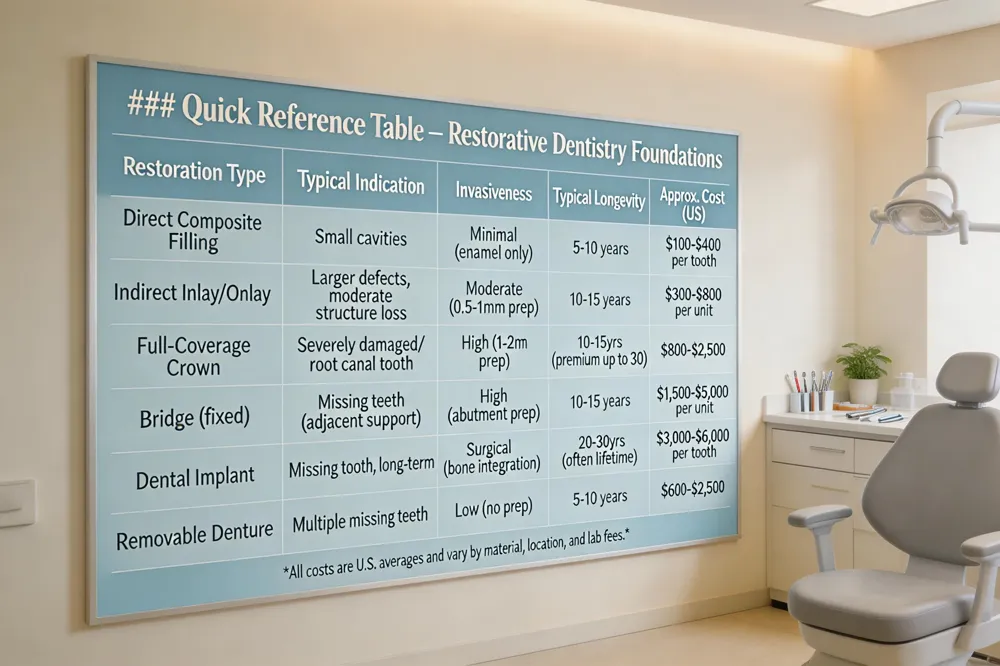
Quick Reference Table – Restorative Dentistry Foundations
| Restoration Type | Typical Indication | Invasiveness | Typical Longevity | Approx. Cost (US) |
|---|---|---|---|---|
| Direct Composite Filling | Small cavities | Minimal (enamel only) | 5‑10 years | $100‑$400 per tooth |
| Indirect Inlay/Onlay | Larger defects, moderate loss of structure | Moderate (0.5‑1 mm prep) | 10‑15 years | $300‑$800 per unit |
| Full‑Coverage Crown | Severely damaged or root‑canal‑treated tooth | High (1‑2 mm prep) | 10‑15 years (premium up to 30) | $800‑$2,500 |
| Bridge (fixed) | Missing tooth(s) with adjacent support | High (prep of abutments) | 10‑15 years | $1,500‑$5,000 per unit |
| Dental Implant | Missing tooth, long‑term solution | Surgical (bone integration) | 20‑30 years (often lifetime) | $3,000‑$6,000 per tooth |
| Removable Denture | Multiple missing teeth | Low (no prep) | 5‑10 years | $600‑$2,500 |
All costs are U.S. averages and vary by material, location, and lab fees.
 Restorative dentistry is the branch of dental care that repairs or replaces damaged or missing teeth to restore oral health, chewing function, and a natural appearance. The primary goal is to preserve as much natural tooth structure as possible while delivering lasting, functional results.
Dental restoration types – Restorations range from simple fillings (composite, porcelain, or metal) that seal cavities to inlays and onlays which are custom‑crafted partial crowns conserving more tooth structure. Full‑coverage crowns and bridges replace severely damaged teeth or span gaps, while thin porcelain veneers improve aesthetics. Permanent solutions such as dental implants and removable dentures replace one or many missing teeth, providing stability and a natural look.
Dental restoration procedure – The process starts with a clinical exam and diagnostic imaging (X‑rays or 3‑D scans). After removing decayed or broken tissue, the tooth is prepared and an impression or digital scan is taken. A temporary restoration may be placed while the final piece—filling, inlay/onlay, crown, bridge, or implant‑supported crown—is fabricated in a lab. The permanent restoration is then bonded or cemented, and the bite is checked for proper fit.
Types of restoration in dentistry – Small cavities receive direct composite fillings; larger defects may need indirect inlays/onlays. Heavily damaged teeth get crowns, and missing teeth are replaced with bridges, dentures, or implant‑supported prostheses.
Basic restorative dental services – Core services include fillings, crowns, bridges, root‑canal therapy, and simple extractions. These procedures repair damage, restore function, and prevent further disease.
Basic vs. major restorative care – Basic care addresses early‑stage issues with minimally invasive, often single‑visit treatments (fillings, simple extractions). Major restorative care handles extensive damage or tooth loss with complex, often surgical options (crowns, bridges, implants, inlays/onlays, full dentures). Basic services are quicker and lower‑cost, while major procedures require multiple visits, laboratory work, and may be covered under higher‑cost dental benefits.
Crowns, Veneers, and Bonding: Pros, Cons, and Longevity
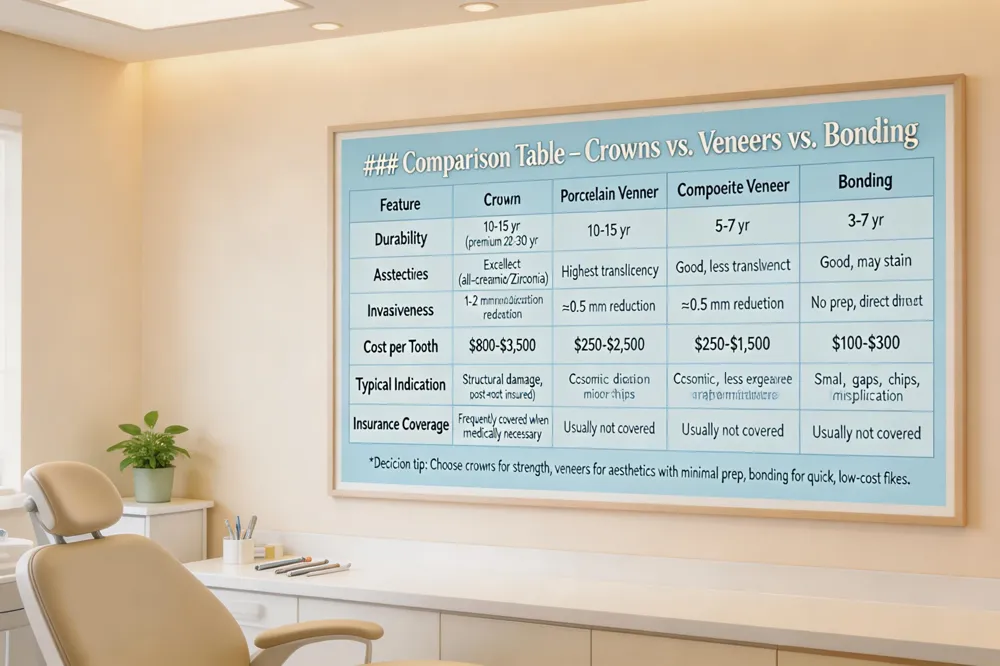
Comparison Table – Crowns vs. Veneers vs. Bonding
| Feature | Crown | Porcelain Veneer | Composite Veneer | Bonding |
|---|---|---|---|---|
| Durability | 10‑15 yr (premium 20‑30 yr) | 10‑15 yr | 5‑7 yr | 3‑7 yr |
| Aesthetics | Excellent (all‑ceramic/zirconia) | Highest translucency | Good, less translucent | Good, may stain |
| Invasiveness | 1‑2 mm tooth reduction | ≈0.5 mm reduction | ≈0.5 mm reduction | No prep, direct application |
| Cost per Tooth | $800‑$3,500 (often insured) | $250‑$2,500 | $250‑$1,500 | $100‑$300 |
| Typical Indication | Structural damage, post‑root‑canal | Cosmetic discoloration, minor chips | Cosmetic, less expensive alternative | Small gaps, chips, minor discoloration |
| Insurance Coverage | Frequently covered when medically necessary | Usually not covered | Usually not covered | Usually not covered |
Decision tip: Choose crowns for strength, veneers for aesthetics with minimal prep, bonding for quick, low‑cost fixes.
 Restorative dentistry offers several ways to repair damaged teeth while keeping your smile natural looking.
Durability – Dental crowns are the most durable, often lasting 10‑15 years (premium gold or all‑ceramic can reach 20‑30 years). Porcelain veneers usually survive 10‑15 years, while composite veneers may need replacement after 5‑7 years. Bonding, though quick and affordable, typically lasts 3‑7 years before a touch‑up or replacement is required.
Aesthetics – Veneers provide the most natural translucency and shade matching, ideal for front‑tooth discoloration, small chips, or gaps. Crowns can also be ultra‑esthetic, especially all‑porcelain or zirconia, but they cover the entire tooth. Bonding matches tooth color well for minor imperfections but may stain over time.
Invasiveness – Veneers require minimal enamel removal (≈0.5 mm). Crowns need more extensive shaping (≈1‑2 mm) to encase the whole tooth. Bonding is the least invasive, applied directly with a curing light and often without anesthesia.
Cost considerations – Porcelain veneers range $250‑$2,500 per tooth; composite veneers are cheaper ($250‑$1,500). Crowns cost $800‑$3,500 (often $1,000‑$2,500 for premium materials). Insurance commonly covers crowns when medically necessary, while veneers are usually out‑of‑pocket. Bonding is the most budget‑friendly option.
Clinical indications – Choose a crown for heavily decayed, cracked, or root‑canal‑treated teeth that need full protection. Veneers suit healthy teeth with cosmetic concerns like stains or minor chips. Bonding works well for small gaps, chips, or discoloration when a conservative, quick fix is desired.
Question answers –
- Veneers vs crowns which last longer? Crowns outlast veneers (10‑15 years vs 10‑15 years for porcelain, 5‑7 years for composite).
- Veneers vs crowns vs bonding? Veneers give superior aesthetics with modest tooth removal; crowns offer the greatest strength and durability; bonding is the least invasive and most affordable for minor defects.
- Veneers vs crowns vs implants? Implants replace missing teeth entirely and last the longest, followed by crowns; veneers are purely cosmetic and need earlier replacement.
- Veneers vs crowns pros and cons? Veneers: excellent look, minimal prep, but less durable. Crowns: full protection, longer life, more prep and cost.
- Which is better crown or veneer? It depends on tooth condition—crowns for structural damage, veneers for cosmetic tweaks.
- Veneers vs crowns price? Veneers $250‑$2,500 per tooth; crowns $800‑$3,500, with crowns more likely covered by insurance.
Our family‑focused team at Veenstra Family Dental uses advanced digital imaging and CAD/CAM technology to design precise restorations, ensuring a comfortable, personalized experience for patients of all ages.
Implants, Bridges, and Comprehensive Costs
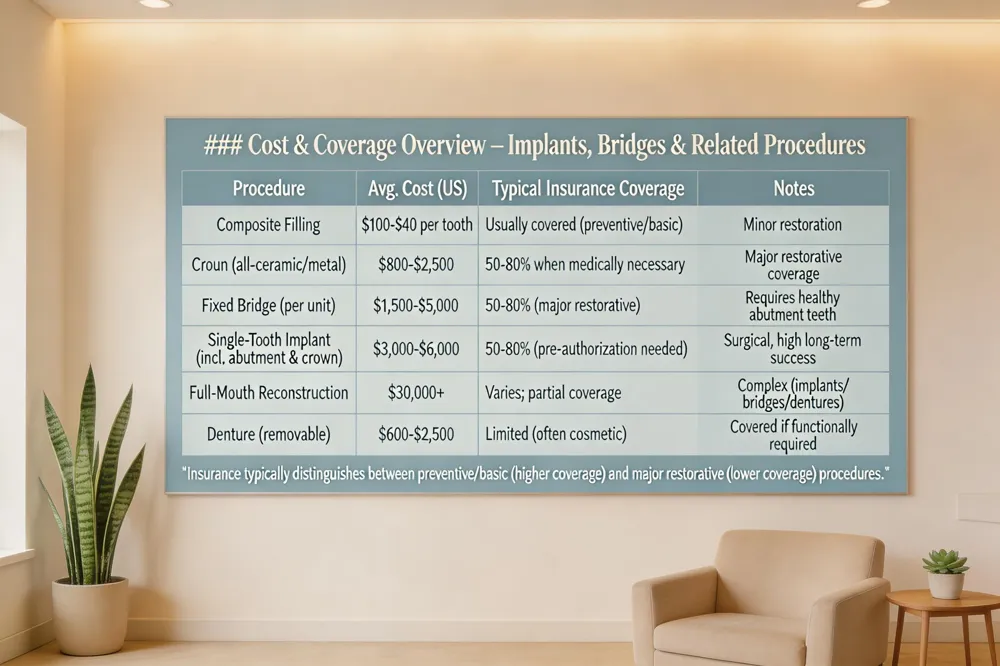
Cost & Coverage Overview – Implants, Bridges & Related Procedures
| Procedure | Avg. Cost (US) | Typical Insurance Coverage | Notes |
|---|---|---|---|
| Composite Filling | $100‑$400 per tooth | Usually covered (preventive/basic) | Minor restoration |
| Crown (all‑ceramic/metal) | $800‑$2,500 | 50‑80 % when medically necessary | Often covered under major restorative |
| Fixed Bridge (per unit) | $1,500‑$5,000 | 50‑80 % (major restorative) | Requires healthy abutment teeth |
| Single‑Tooth Implant (incl. abutment & crown) | $3,000‑$6,000 | 50‑80 % (may require pre‑authorization) | Surgical placement, high long‑term success |
| Full‑Mouth Reconstruction | $30,000+ | Varies; often partial coverage | Complex, may include implants, bridges, dentures |
| Denture (removable) | $600‑$2,500 | Limited coverage; often considered cosmetic | May be covered if functionally required |
Insurance typically distinguishes between preventive/basic (higher coverage) and major restorative (lower coverage) procedures.
 Bridge solutions use crowns on adjacent teeth to support a false tooth (pontic), effectively closing gaps without surgery. Modern bridges, often fabricated with CAD/CAM technology, are durable, aesthetically pleasing, and ideal when implants are not feasible.
Cost breakdown (U.S. averages): composite fillings $100‑$400 per tooth; crowns $800‑$2,500; bridges $1,500‑$5,000 per unit; single‑tooth implants $3,000‑$6,000 (including post, abutment, and crown). Full‑mouth reconstructions can exceed $30,000, while simple restorations remain on the lower end of the spectrum.
Insurance coverage typically includes medically necessary procedures such as crowns, bridges, and implants, while purely cosmetic options like porcelain veneers often receive limited or no coverage. Most plans cover a portion of the cost, and many offices offer flexible financing to reduce out‑of‑pocket expenses.
Safety and durability: implants and ceramic crowns are biocompatible and resistant to staining, offering long‑term success rates over 95%. Proper oral hygiene, regular check‑ups, and protective night guards (for bruxism) further extend the lifespan of any restoration.
Frequently asked questions:
- Which is the safest teeth cosmetic restoration? Dental implants, followed by porcelain veneers and ceramic crowns, provide the most reliable and biocompatible outcomes.
- Restorative Dentistry cost? See the cost breakdown above; prices vary by material, case complexity, and any preparatory work such as bone grafts.
- Restorative dentistry near me? Veenstra Family Dental in Midland Park, NJ offers same‑day crowns, bridges, implants, and other restorative services using advanced digital imaging and CAD/CAM technology.
- How much does restorative dental work cost? Costs range from $100‑$400 for fillings to $3,000‑$6,000 for implants, with insurance often covering a portion.
- Teeth restoration price? Similar ranges apply; detailed estimates are provided during the initial consultation.
- List of dental procedures and prices? Routine exams $75‑$200, cleanings $75‑$200, extractions $75‑$250, root canals $500‑$1,200, and dentures $600‑$2,500.
Contact Veenstra Family Dental today for a personalized treatment plan and transparent pricing tailored to your smile.
Prosthodontics and Advanced Materials
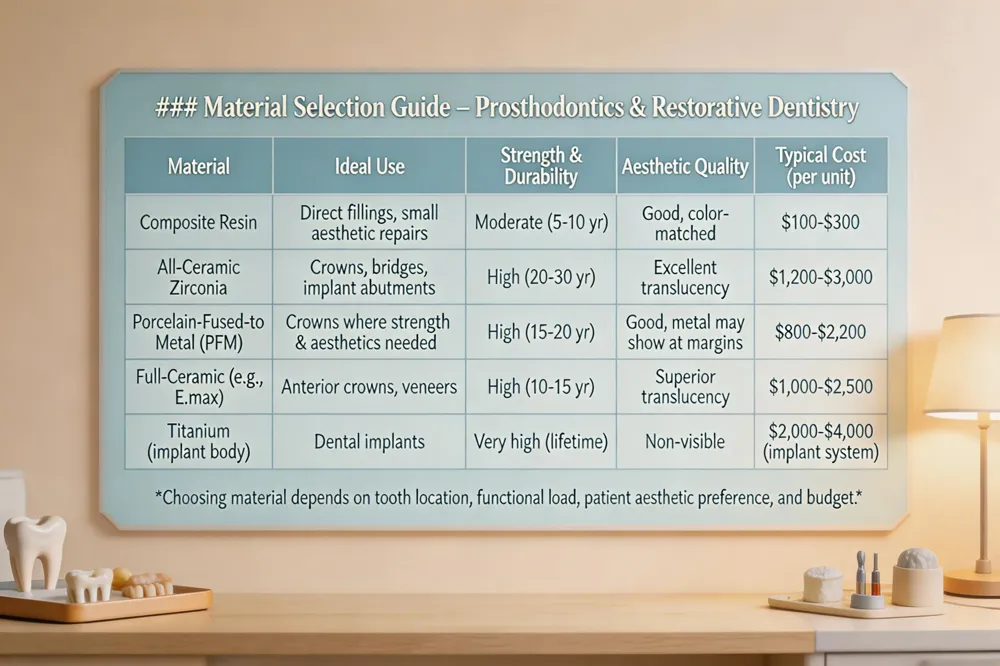
Material Selection Guide – Prosthodontics & Restorative Dentistry
| Material | Ideal Use | Strength & Durability | Aesthetic Quality | Typical Cost (per unit) |
|---|---|---|---|---|
| Composite Resin | Direct fillings, small aesthetic repairs | Moderate (5‑10 yr) | Good, color‑matched | $100‑$300 |
| All‑Ceramic Zirconia | Crowns, bridges, implant abutments | High (20‑30 yr) | Excellent translucency | $1,200‑$3,000 |
| Porcelain‑Fused‑to‑Metal (PFM) | Crowns where strength & aesthetics needed | High (15‑20 yr) | Good, metal may show at margins | $800‑$2,200 |
| Full‑Ceramic (e.g., E.max) | Anterior crowns, veneers | High (10‑15 yr) | Superior translucency | $1,000‑$2,500 |
| Titanium (implant body) | Dental implants | Very high (lifetime) | Non‑visible | $2,000‑$4,000 (implant system) |
Choosing material depends on tooth location, functional load, patient aesthetic preference, and budget.
 Restorative dentistry repairs damaged or decayed teeth with fillings, crowns, bridges, inlays/onlays, implants and dentures—often performed by a family dentist. Prosthodontics, a specialty, replaces missing or severely damaged teeth with custom prosthetic appliances—crowns, bridges, full or partial dentures, implants—and also treats TMJ disorders and complex aesthetic cases. Both fields may use crowns and implants, but prosthodontic care involves full‑arch or removable‑fixed solutions and requires additional training. At Veenstra Family Dental, restorative care restores function while prosthodontics provides long‑lasting replacement options for lost teeth, helping patients achieve reliable chewing, clear speech, and a natural‑looking smile.
The best restorative material varies: high‑quality composite resin is ideal for direct fillings, all‑ceramic zirconia offers durability and biocompatibility for crowns, and porcelain‑fused‑to‑metal provides superior translucency when aesthetics dominate. Material choice is guided by tooth location, functional demands, and patient preferences, and is refined through digital imaging and CAD/CAM workflows to ensure precise, lasting results.
Insurance, Coverage, and Getting Started
Dental Benefits Cheat‑Sheet
| Benefit Category | Typical Coverage | Annual Maximum | Common Procedures Covered |
|---|---|---|---|
| Preventive ( exams, cleanings, X‑rays | 100 % (after deductible) | $1,500‑$2,000 | Exams, prophylaxis, sealants |
| Basic Restorative (fillings, simple extractions) | 70‑80 % | $1,500‑$2,000 | Composite fillings, simple extractions |
| Major Restorative (crowns, bridges, implants, dentures) | 50‑80 % | $1,500‑$2,000 | Crowns, bridges, implant‑supported crowns, dentures |
| Orthodontics (if included) | Varies (often 50 %) | $1,500‑$3,000 | Braces, aligners |
Getting Started:
- Review your policy’s max and deductible.
- Schedule a comprehensive exam.
- Discuss a treatment plan & cost estimate.
- Verify pre‑authorization for major procedures.
- Explore financing or payment plans if needed.
Veenstra Family Dental accepts most major plans and offers flexible financing to bridge any out‑of‑pocket gaps.
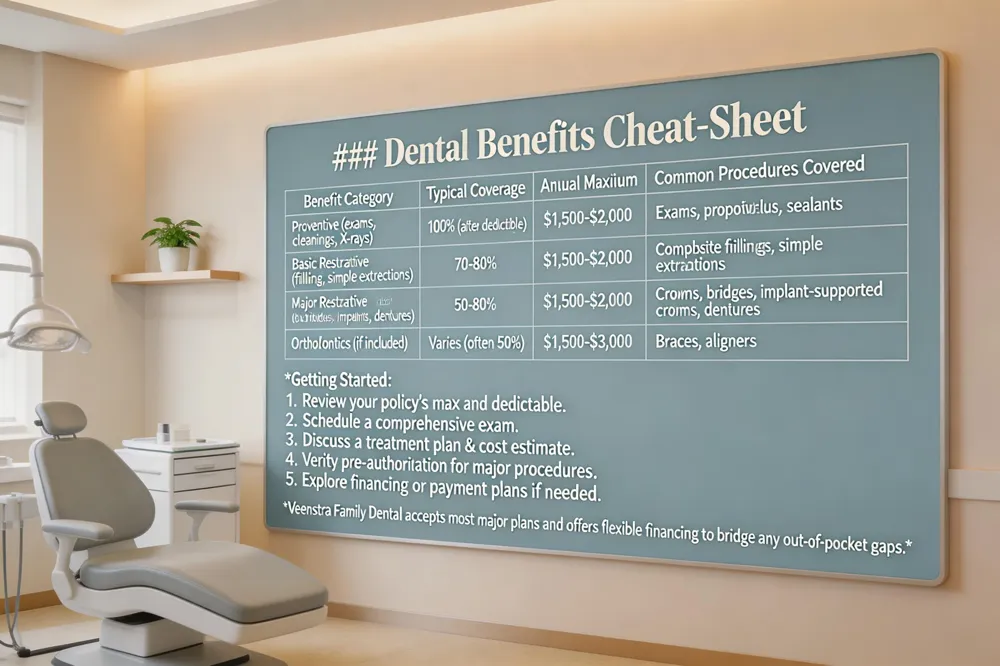 Understanding dental benefits is the first step toward a healthy smile. Insurance basics — most plans divide coverage into preventive, basic and major restorative categories, with a yearly maximum (often $1,500‑$2,000). Coverage details — major restorative dental insurance typically pays 50‑80 % of procedures such as crowns, bridges, dentures, and sometimes implants after the deductible is met; exact percentages depend on the carrier and network status. Financing options — Veenstra Family Dental accepts most major insurance, offers flexible payment plans, and provides sedation‑comfort options to ease costs. Next steps — review policy, schedule an exam, and discuss a treatment plan with our team.
Your Path to a Restored Smile
Call our office today to schedule a personalized visit—our team will assess your needs and discuss the best restorative plan. We accept most major insurance and offer flexible financing, including payment plans and discounts, so treatment is affordable. Maintaining your restorations with regular check‑ups ensures lasting oral health and a confident smile.