Understanding Your Crown Options
When you need a dental crown, you have two modern pathways: a same‑day (CEREC) crown or a traditional laboratory‑crafted crown. Same‑day crowns are designed, milled, and placed in one visit using an intra‑oral scanner and CAD/CAM milling, eliminating the uncomfortable putty impression and the need for a temporary crown. Traditional crowns require two appointments, a physical impression, and a lab‑fabricated restoration, offering a broader menu of materials such as metal, porcelain‑fused‑to‑metal, gold, or all‑ceramic. Material choice influences strength, durability, and how naturally the crown blends with your smile. At Veenstra Family Dental, we combine cutting‑edge CEREC technology with a compassionate, family‑focused approach, allowing each patient—young or adult—to receive a precise, comfortable restoration that fits their lifestyle and aesthetic goals.
Same‑Day Crowns: How They Work and Who Benefits
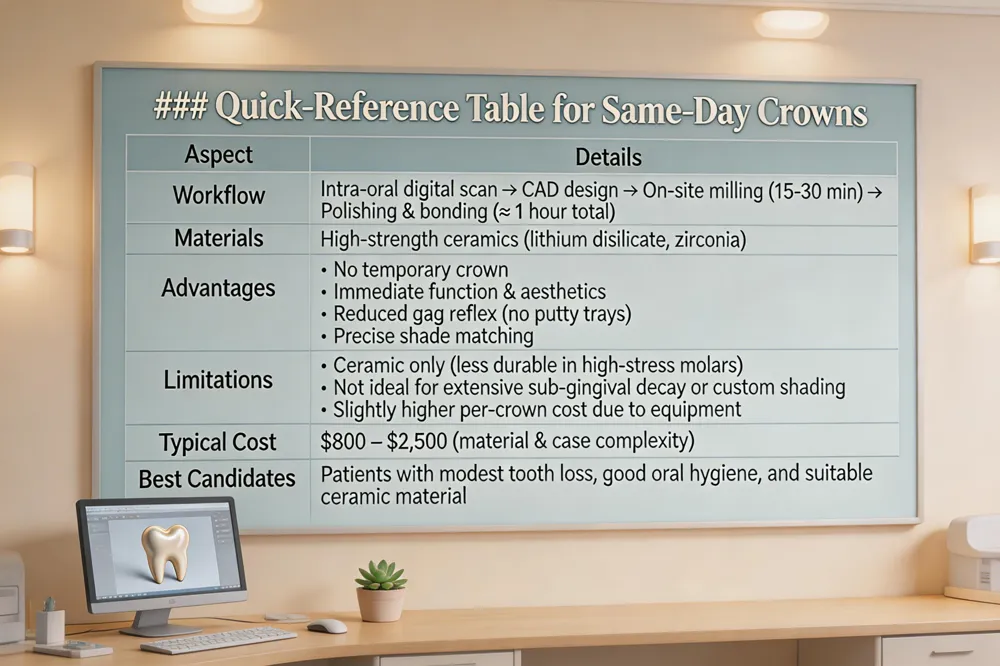
Quick‑Reference Table for Same‑Day Crowns
| Aspect | Details |
|---|---|
| Workflow | Intra‑oral digital scan → CAD design → On‑site milling (15‑30 min) → Polishing & bonding (≈1 hour total) |
| Materials | High‑strength ceramics (lithium disilicate, zirconia) |
| Advantages | • No temporary crown<br>• Immediate function & aesthetics<br>• Reduced gag reflex (no putty trays)<br>• Precise shade matching |
| Limitations | • Ceramic only (less durable in high‑stress molars)<br>• Not ideal for extensive sub‑gingival decay or custom shading<br>• Slightly higher per‑crown cost due to equipment |
| Typical Cost | $800 – $2,500 (material & case complexity) |
| Best Candidates | Patients with modest tooth loss, good oral hygiene, and suitable ceramic material |
 At Veenstra Family Dental we use CEREC® chair‑side CAD/CAM technology to create a permanent crown in a single visit. First, an intra‑oral scanner captures a precise 3‑D digital impression of the prepared tooth, eliminating uncomfortable putty trays. The image is sent to design software where the dentist selects a shade and designs the restoration on screen. An on‑site milling machine then carves the crown from a solid block of high‑strength ceramic (typically lithium disilicate or zirconia) in about 15‑30 minutes, after which the crown is polished, adjusted and bonded.
Advantages – No temporary crown is needed, so patients avoid the discomfort and risk of dislodgement. The entire workflow takes roughly one hour, restoring function and aesthetics immediately. Digital impressions improve fit, reduce gag reflex, and allow instant shade matching.
Limitations – Same‑day crowns are currently limited to all‑ceramic materials, which may be less durable in high‑stress molar regions compared with metal‑based lab crowns. Severe sub‑gingival decay, extensive tooth loss, or the need for custom shading may require a traditional laboratory‑fabricated restoration. The equipment and expertise required can make the per‑crown cost slightly higher than a conventional crown.
One‑day crowns – Also called same‑day or CEREC crowns, they are custom‑fabricated porcelain restorations placed in one appointment, giving you a permanent, metal‑free restoration that looks natural and functions immediately.
Same‑day crowns near me – Veenstra Family Dental in Midland Park, NJ offers fast chairside CEREC® crowns, delivering a seamless, durable restoration in a single visit with compassionate, family‑focused care.
Can dental crowns be done in one day? – Yes. With CAD/CAM technology the dentist prepares the tooth, takes a digital impression, mills the crown on‑site and bonds it all in one appointment—ideal for patients with modest tooth loss and suitable ceramic material.
CEREC crown – A same‑day, computer‑crafted ceramic crown that mimics natural enamel, provides strong, long‑lasting function (10‑15 years), and eliminates the need for multiple visits.
Same‑day crowns disadvantages – Limited to ceramic materials (potentially less durable than metal), not ideal for extensive gum‑root damage, shade‑matching can be challenging, and the technology may be less accessible, sometimes resulting in higher costs.
Traditional Crowns: Process, Materials, and When They Shine
Traditional Crown Workflow & Materials
| Step / Material | Description |
|---|---|
| Two‑Visit Workflow | 1️⃣ Tooth preparation & physical impression → Temporary crown placed<br>2️⃣ Lab fabricates permanent crown (1‑2 weeks) → Final crown seated |
| Material Options | • All‑metal<br>• Porcelain‑fused‑to‑metal (PFM)<br>• All‑ceramic (zirconia, lithium disilicate)<br>• Gold alloys |
| Ideal Use Cases | • High‑stress posterior molars (metal‑based or zirconia for durability)<br>• Extensive sub‑gingival damage<br>• Custom shade matching<br>• Multi‑unit bridges |
| Durability | Metal‑based & high‑strength zirconia crowns excel in heavy bite forces; proven longevity |
| Typical Cost | $800 – $2,500 (varies by material & complexity) |
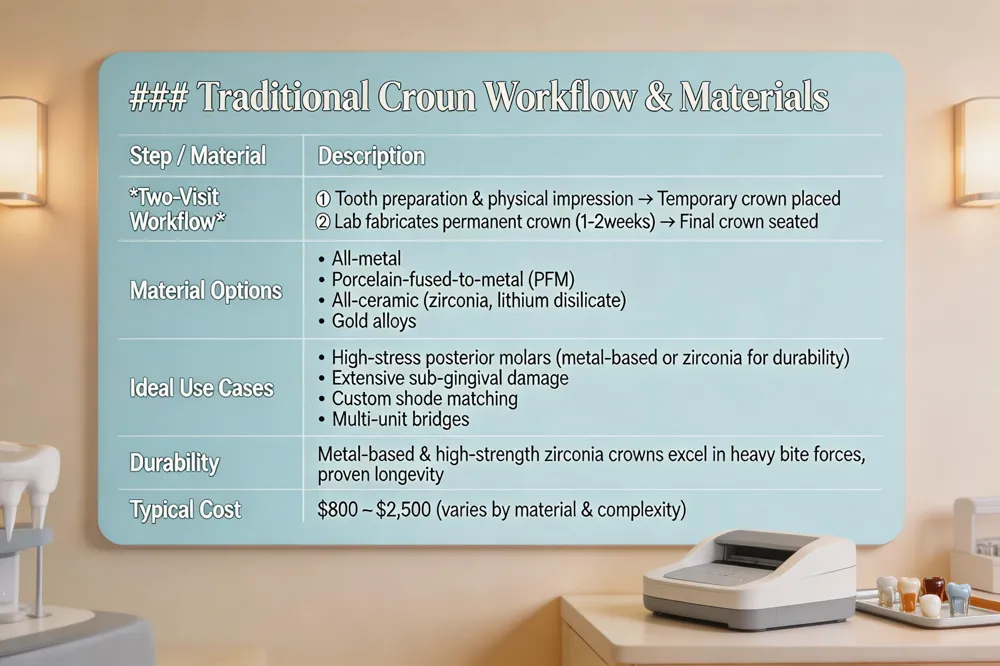 Two‑Visit Workflow – Traditional crowns begin with a tooth preparation and a physical impression. A temporary crown protects the tooth while the laboratory fabricates the permanent restoration, usually within 1–2 weeks. The second visit seats the final crown.
Material Options – Labs can craft crowns from a wide range of materials: all‑metal, porcelain‑fused‑to‑metal (PFM), all‑ceramic (including zirconia and lithium disilicate), and gold alloys. This variety lets the dentist match strength and aesthetics to each case.
Durability for High‑Stress Teeth – Metal‑based and high‑strength zirconia crowns excel in posterior molars that endure heavy bite forces. Their proven longevity makes them the go‑to choice for patients who grind or have large occlusal loads.
When Lab‑Crafted Crowns Shine – Complex cases—such as extensive sub‑gingival damage, custom shading for a perfect shade match, or multi‑unit bridges—benefit from the extra time and artistry a dental laboratory provides.
Major Restorative Dental – Major restorative care includes crowns, bridges, dentures, and implants that replace severely damaged teeth. These procedures often require multiple visits and are classified as Class 3 services by insurance, covering a lower percentage of costs.
Dental Restoration Materials – Restorations can be built from composite resin, glass ionomer, amalgam, high‑strength ceramics, zirconia, or gold alloys. The choice balances durability, aesthetics, cost, and the tooth’s functional demands.
Dental Restoration Types – Direct restorations (fillings) are placed in the mouth, while indirect restorations (crowns, bridges, veneers, inlays, onlays) are fabricated in a lab and then cemented.
Are Same‑Day Crowns as Good as Regular Crowns? – Same‑day CAD/CAM crowns offer comparable strength and aesthetics for most front‑ and moderate‑load teeth, eliminating temporary crowns and a second visit. However, traditional lab‑crafted crowns—especially metal‑ceramic designs—often provide a slightly superior internal fit and may be preferred for heavy‑stress posterior teeth or cases requiring extensive customization.
Cost Considerations: Pricing for Crowns, Fillings, and Major Restorations
Pricing Overview (Midland Park, NJ)
| Procedure | Price Range | Influencing Factors |
|---|---|---|
| Composite filling | $100 – $400 per tooth | Size of decay, location |
| Full crown | $800 – $2,500 | Material (ceramic vs. metal), case complexity |
| Bridge | $1,500 – $5,000 | Number of units, materials |
| Implant (crown on implant) | $3,000 – $6,000 per tooth | Implant system, bone grafting needs |
| Veneer | $1,000 – $2,500 | Material, number of teeth |
Insurance may cover a portion of medically necessary procedures; Veenstra offers financing and interest‑free options for qualified patients.
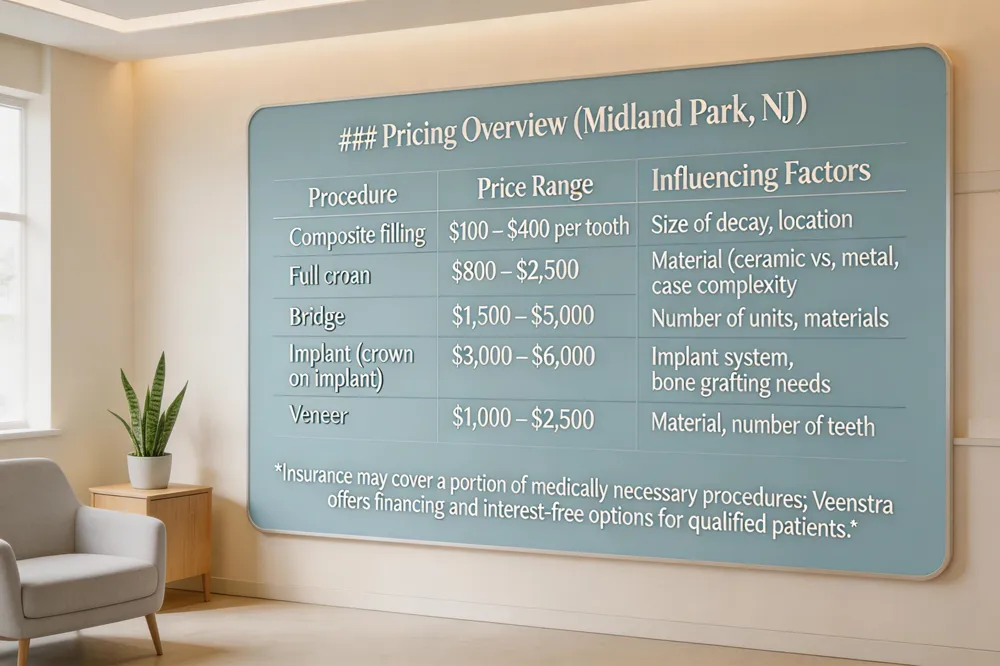 At Veenstra Family Dental in Midland Park, NJ we strive to make high‑quality restorative care affordable for every family.
Typical price ranges – A simple composite filling usually costs $100‑$400 per tooth, while a full crown falls between $800‑$2,500 depending on material and case complexity. Bridges start at $1,500 and can reach $5,000; implants, the most permanent option, range from $3,000‑$6,000 per tooth.
Material and case complexity – All‑ceramic (zirconia or lithium disilicate) crowns, which are metal‑free and highly aesthetic, tend toward the higher end of the range. Metal‑ceramic or gold‑based crowns may be slightly less expensive but offer superior strength for heavy‑bite areas. Extensive tooth damage or sub‑gingival margins often require additional lab work, increasing the cost.
Insurance and financing – Most dental plans cover a portion of medically necessary crowns and fillings. Veenstra works directly with insurers to maximize benefits and offers flexible financing plans, including interest‑free options for qualified patients.
Economic factors for local families – Midland Park residents benefit from competitive pricing, transparent estimates, and a welcoming, family‑focused environment that reduces travel time and missed work. Our modern CAD/CAM technology also eliminates temporary crowns and extra appointments, saving both time and money.
Answering your key questions – Restoring a front tooth typically costs $100‑$400 for a filling and $800‑$2,500 for a custom crown; veneers run $1,000‑$2,500. Same‑day crowns are not automatically more expensive; they often match or undercut traditional lab crowns because they skip lab fees and a second visit. A tooth‑restoration filling removes decay and restores function using composite, amalgam, or indirect inlay/onlay options, all tailored to the tooth’s location and your budget.
Patient Experience: Comfort, Convenience, and Long‑Term Success
Patient‑Experience Highlights
| Factor | How It Improves Experience |
|---|---|
| Digital Scanning | Eliminates messy putty trays; reduces gag reflex; provides accurate 3‑D impression |
| No Temporary Crown | Avoids soreness, looseness, and risk of dislodgement; patient leaves with permanent restoration |
| Appointment Efficiency | Single‑visit workflow saves time and reduces travel/appointments missed |
Post‑Procedure Care | Brush twice daily with fluoride toothpaste, floss nightly, avoid hard foods for 24 hrs, consider nightguard if bruxism | | Long‑Term Success | Proper hygiene + regular check‑ups maintain crown integrity for 10‑15 years |
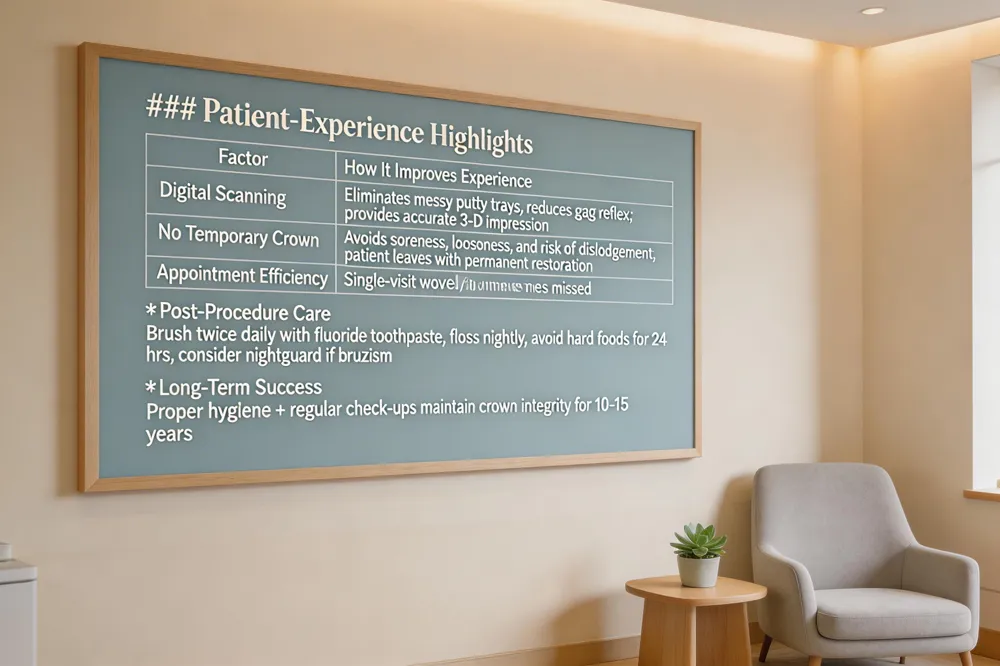
Digital scanning vs. traditional impressions
Modern CAD/CAM systems at Veensta Family Dental capture a 3‑D digital image of the prepared tooth with an intra‑oral scanner. This eliminates the messy, gag‑inducing putty trays used for conventional impressions and provides a highly accurate replica that guides precise crown design.
Elimination of temporary crowns and related discomfort
Because the crown is milled and placed in the same visit, a provisional crown is unnecessary. Patients avoid the common issues of temporary crowns—soreness, looseness, and accidental dislodgement—leaving the office with a permanent, fully functional restoration.
Post‑procedure care and maintenance for lasting results
Maintain excellent oral hygiene by brushing twice daily with fluoride toothpaste and flossing each night. Avoid chewing extremely hard or sticky foods for the first 24 hours, and schedule regular check‑ups. If grinding (bruxism) is a concern, a nightguard can protect the new crown.
How Veenstra Family Dental supports families throughout treatment
Our team offers a warm, family‑focused environment, explains each step in plain language, and tailors the crown workflow to the patient’s schedule and needs. We provide digital previews, answer questions, and ensure follow‑up visits are smooth and stress‑free.
Same‑day crowns disadvantages Same‑day crowns are typically made only from ceramic or porcelain, which can be less durable and more prone to chipping than metal‑based or multi‑material crowns. They may not be suitable for patients with extensive gum‑root issues or complex oral conditions, limiting their use to relatively straightforward cases. Because the restoration is fabricated in a single visit, the shade‑matching process can be more challenging, sometimes resulting in a less natural appearance. The technology and expertise required for chair‑side milling are not available in every practice, making access to qualified providers more limited. Finally, the cost of a same‑day crown can be higher than a traditional crown, especially when the dentist must use specialized CAD/CAM equipment and materials.
Dental restoration procedure A dental restoration procedure is a treatment that rebuilds the natural structure of a damaged, decayed, or missing tooth to restore its function and appearance. First, the dentist removes any decayed tissue and thoroughly cleans the area, then the appropriate material—such as composite resin for a filling or a custom‑fabricated crown, bridge, or implant abutment—is placed to fill the cavity or cover the tooth. Advanced digital imaging and intra‑oral scanners often guide the design, ensuring a precise fit that matches the surrounding teeth. The restored tooth is then polished and adjusted for comfortable biting and speech. This process helps prevent further decay, improves chewing efficiency, and can enhance the smile’s aesthetics.
Making the Right Choice for Your Smile
When the weigh same‑day crowns against traditional restorations, consider both convenience and material durability. Same‑day CAD/CAM crowns give you a permanent, metal‑free restoration in one visit, while conventional crowns offer a broader palette of materials—metal, PFM, gold, or layered ceramics—that may provide extra strength for heavily loaded molars. Bring your lifestyle, aesthetic goals, and any metal sensitivities to the conversation at Veenstra Family Dental. Our team will review your tooth condition, bite forces, and budget to recommend the best option. Ready to move forward? Call or request an online appointment, and we’ll discuss financing plans that keep your smile healthy and affordable.